
.png?width=48&height=48&name=Group%201%20(3).png)























17 February, 2026

Understanding Speech Sound Disorders: Is It Apraxia of Speech?
"I know what I want to say, but my mouth won't do it."
If a child could articulate the frustration of Apraxia of speech, that is likely what they would tell you. As a parent, watching your child struggle to communicate is heartbreaking. You see the effort, the intent, and the intelligence behind their eyes, but the words just don't come out clearly.
You might be noticing that your child is hard to understand compared to their peers. Perhaps they can say a word perfectly one day, but the next day, it sounds completely different. Or maybe they seem to be searching for the right movements with their jaw and lips, trying to force the sounds out.
These are not just "cute" toddler quirks. They are often signs of Speech sound disorders.
Navigating the world of speech pathology can be confusing. Terms like "articulation," "phonology," and "apraxia" are often thrown around, leaving parents wondering what is actually going on.
In this guide, we will break down the difference between general Speech sound disorders and the specific challenge of Apraxia of speech. We will explain the speech delay diagnosis process and show you how targeted Speech Therapy can help your child find their voice.
What Are Speech Sound Disorders?
Speech sound disorders are an umbrella term. It refers to any difficulty or combination of difficulties with perception, motor production, or phonological representation of speech sounds and speech segments.
Simply put, it is when a child has trouble making the sounds of their language correctly.
Most Speech sound disorders fall into two main categories:
1. Articulation Disorders
This is a problem with the mechanics of speech. The child has trouble physically placing their tongue, lips, or jaw to make a specific sound.
- Example: A lisp (saying "thun" for "sun") or substituting "W" for "R" (saying "wabbit" for "rabbit"). The error is usually consistent.
2. Phonological Disorders
This is a problem with the patterns of speech. The child can physically make the sounds, but their brain organizes them incorrectly.
- Example: "Fronting," where all sounds made in the back of the mouth (like K and G) are moved to the front (saying "tea" for "key").
Zooming In: What is Apraxia of Speech?
Apraxia of speech (specifically Childhood Apraxia of Speech or CAS) is different. It is not a muscle weakness, and it is not just a pattern error.
Apraxia of speech is a motor planning disorder.
Think of the brain as a GPS and the mouth as the car. In a typical speaker, the GPS sends a clear route to the car, and the car drives there smoothly. In a child with Apraxia, the GPS signal is scrambling. The child knows what they want to say, but the brain struggles to tell the muscles of the mouth, jaw, and tongue exactly how to move, in what order, and with what timing to produce the words.
Signs of Apraxia of Speech
Unlike other Speech sound disorders, Apraxia has distinct red flags:
- Inconsistent Errors: A child might say "banana" correctly once, then say "nana," "bana," or "mama" the next time.
- Groping: You might see physical struggle—the child’s mouth moving, searching for the right position before a sound comes out.
- Vowel Distortions: Most children with articulation issues still get their vowels right (A, E, I, O, U). Children with Apraxia often distort these sounds.
- Loss of Words: A child might be able to say "automatic" words (like "hi" or "no") easily, but struggle when asked to say the same word on command.
The Importance of a Speech Delay Diagnosis
Because Apraxia of speech looks so different from other Speech sound disorders, getting an accurate speech delay diagnosis is critical.
Standard Speech Therapy techniques that work for articulation (like "put your tongue here") often fail with Apraxia because the issue isn't about knowing where the tongue goes—it's about the brain coordinating the movement to get it there.
When you seek an evaluation, a Speech-Language Pathologist (SLP) will look for:
- Motor Planning: Can the child imitate mouth movements? Can they switch between sounds (e.g., "pa-ta-ka") quickly?
- Prosody: Does the child’s speech sound robotic or choppy? (A common sign of Apraxia).
- Consistency: Are the errors the same every time, or do they change?
A correct diagnosis ensures that your child gets the right kind of therapy.
How Speech Therapy Treats Apraxia
Treating Apraxia of speech requires a specialized approach based on "motor learning principles."
While traditional therapy might focus on saying a sound in isolation, therapy for Apraxia focuses on movement.
- Repetition is Key: The goal is to build new neural pathways. This requires high-repetition practice of specific words and phrases.
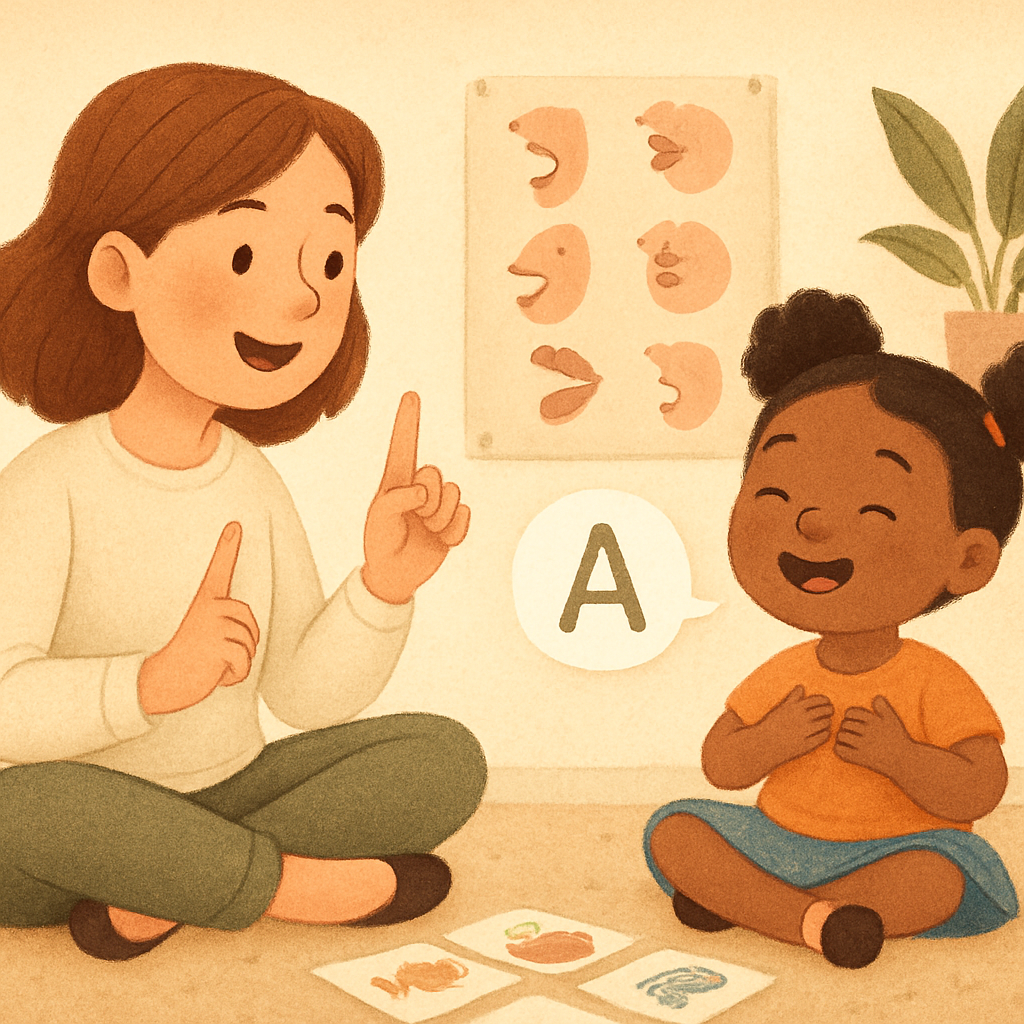
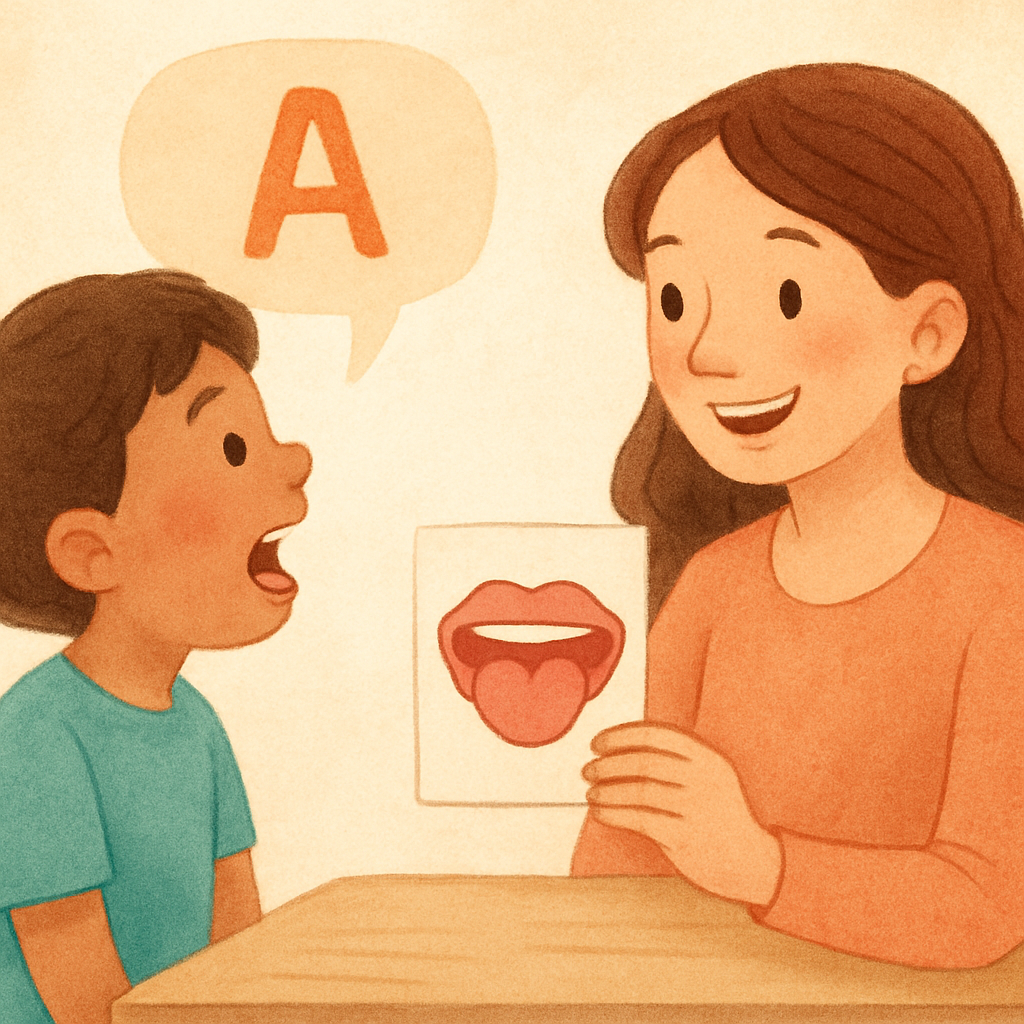
- Multi-Sensory Cues: The therapist might use touch cues (touching the child's face to signal a sound), visual cues (watching the therapist's mouth), and auditory cues simultaneously.
Focus on Rhythm: Therapy often incorporates tapping, clapping, or melody to help the child find the natural rhythm of speech.
With consistent, specialized Speech Therapy, children with Apraxia can make incredible progress. The brain is plastic, and with the right practice, it can learn to plan these movements effectively.
Conclusion
Hearing that your child has a diagnosis like Apraxia of speech or complex Speech sound disorders can be scary. It sounds serious, and the road ahead can seem long.
But knowledge is power. Understanding that your child’s struggle is a motor planning issue—not a lack of intelligence or effort—changes everything. It allows you to advocate for the specific type of Speech Therapy that actually works.
Your child has so much to say. With the right support, patience, and practice, you can help them bridge the gap between their brain and their mouth, unlocking a lifetime of connection.
If you are concerned about your child’s speech clarity or suspect Apraxia of speech, we are here to help. Our team of experienced Speech-Language Pathologists specializes in differential diagnosis and motor-planning therapy.
Contact Us Today to schedule a consultation or call daar at 02 9133 2500 for an evaluation and start your child’s journey to finding their voice.
FAQ: Common Questions for Parents
Will my child grow out of Apraxia of Speech?
No. Unlike some developmental speech delays, Apraxia of speech is not something a child simply outgrows. It requires specific, intensive intervention to train the brain to plan speech movements.
Is Apraxia the same as a speech delay?
No. A speech delay usually means the child is following the typical path of development but at a slower rate. Apraxia of speech is a disorder where the path of development is atypical. A speech delay diagnosis will differentiate between the two.
Can a child have Apraxia and other Speech sound disorders?
Yes. It is possible for a child to have Apraxia along with phonological issues or muscle weakness (Dysarthria). An SLP will treat the most impacting condition first.
.svg)




.svg)