
.png?width=48&height=48&name=Group%201%20(3).png)
























13 March, 2026

How ADHD and Autism Overlap: A Comprehensive Guide
Key Highlights
Here are the key takeaways from our guide on the overlap between ADHD and autism:
- ADHD and autism are both neurodevelopmental disorders that frequently co-occur, with many individuals showing traits of both.
- The term "AuDHD" is sometimes used to describe the experience of having both ADHD and autism.
- Shared characteristics include challenges with executive function, social interactions, sensory differences, and emotional regulation.
- Key differences exist; for example, people with ADHD may seek novelty, while autistic individuals often prefer routine and structure.
- A comprehensive diagnosis from a professional familiar with both conditions is crucial for creating an effective and personalized support plan.
Introduction
Have you ever wondered about the connection between Attention-Deficit/Hyperactivity Disorder (ADHD) and Autism Spectrum Disorder (ASD)? These two common neurodevelopmental disorders share more than you might think. While they are distinct conditions, their symptoms can overlap, sometimes making diagnosis tricky. Understanding this relationship is the first step toward finding the right support and strategies for individuals who experience traits of one or both. This guide will explore the similarities, differences, and what it means to live with both ADHD and autism.
Understanding ADHD and Autism in Australia
Attention Deficit Hyperactivity Disorder (ADHD) and autism are neurodevelopmental conditions affecting many people in Australia and worldwide. It’s common to have both; ADHD is the most frequent co-occurring condition in children with autism, with research showing up to 28% of autistic children also meet criteria for ADHD.
Accurate diagnosis is crucial, as these conditions share many traits. A thorough evaluation helps distinguish between them or confirm if both are present, which is key for effective support. Let’s look at what defines each condition.
Defining ADHD: Key Features and Prevalence
Attention-Deficit/Hyperactivity Disorder (ADHD) is marked by ongoing inattention, impulsivity, and hyperactivity. Accurate diagnosis requires a comprehensive evaluation by a professional who can distinguish ADHD from similar conditions through a review of behavior and history across different settings.
ADHD symptoms vary: some people struggle mainly with inattention, others with hyperactivity and impulsivity, and many experience both. These traits must start in childhood and significantly affect daily life.
ADHD affects about 3% of adults and often lasts a lifetime. While it brings challenges, many also recognize strengths like creativity, energy, and flexible thinking. Understanding these features is key to effective management.
Defining Autism Spectrum: Characteristics and Trends
Autism Spectrum Disorder (ASD) involves unique challenges with social interaction, communication, and behavior. A key difference between autism and ADHD is the reason behind certain behaviors—for example, autistic individuals may miss social cues due to difficulty understanding them, while those with ADHD may do so out of inattention.
Autism is usually diagnosed by observing traits like struggles with social-emotional skills, a need for routine, repetitive behaviors, intense interests, and sensory sensitivities. These traits vary widely among individuals, which is why ASD is called a spectrum. Social difficulties and repetitive behaviors are central to autism and help distinguish it from other conditions with overlapping symptoms.
Neurodevelopmental Differences: A Shared Foundation
Both ADHD and autism are neurodevelopmental disorders, stemming from differences in brain development. This common foundation explains their frequent overlap. Research and family studies show significant genetic similarities, indicating shared risk factors for both conditions.
"AuDHD" is a term used in the neurodiversity community to describe individuals with both autism and ADHD. It reflects the unique challenges of managing traits that may conflict—such as autism’s preference for routine versus ADHD’s desire for novelty—as well as shared traits like intense focus.
Understanding this connection is vital for mental health and early intervention. Recognizing their shared biological roots—genetic or environmental—leads to more accurate diagnosis and better support, shifting the view away from treating them as entirely separate issues.
Symptom Overlap Between ADHD and Autism
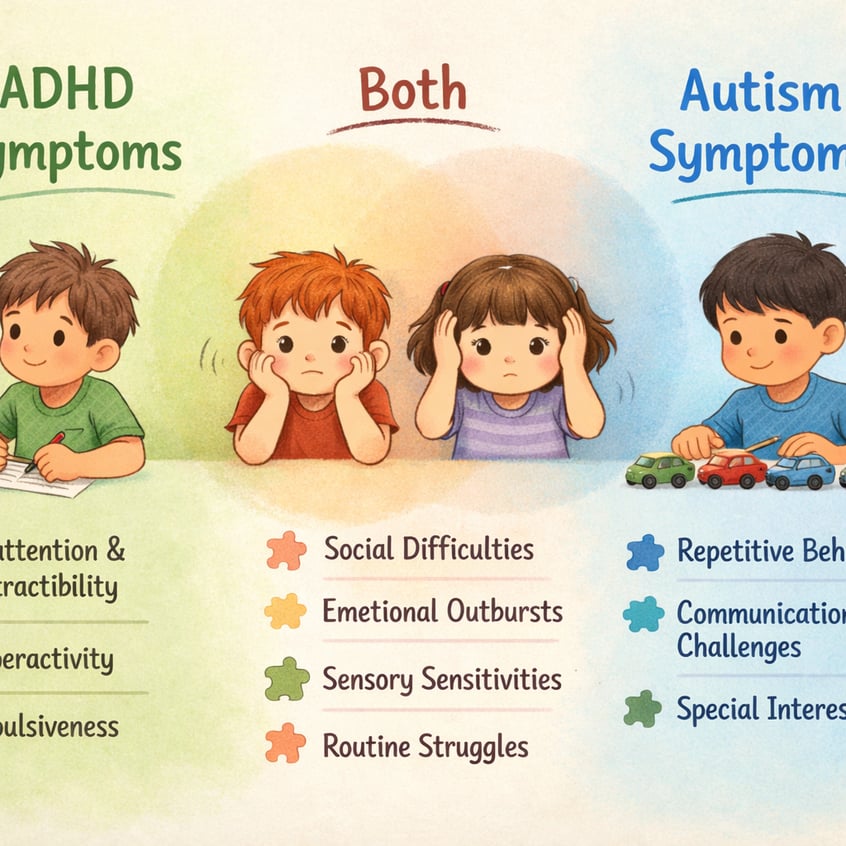
The main overlap in symptoms between ADHD and Autism Spectrum Disorder lies in areas like executive functioning, social interaction, and certain repetitive behaviors. Both conditions can make it difficult to manage daily tasks, regulate emotions, and navigate social situations. For example, challenges with paying attention and organizing thoughts are common in both.
Because of this crossover, it can be challenging to distinguish between ADHD symptoms and autistic traits without a thorough evaluation. We will now explore some of these specific overlapping areas in more detail, including behavioral traits, executive function struggles, and social communication similarities.
Overlapping Behavioral Traits
One of the most significant areas of overlap involves behavioral traits. Both individuals with ADHD and autistic individuals can experience challenges that look similar on the surface, making it difficult to distinguish between ADHD traits and autistic traits without deeper analysis.
These shared behaviors often create similar difficulties in daily life, especially at school or work. The core reasons might differ, but the outward presentation can be confusing for parents, teachers, and even clinicians. Some of the main ways ADHD and autism overlap in symptoms include:
- Inattention: Difficulty focusing on tasks that aren't highly engaging.
- Hyperactivity: Being restless or constantly "on the go."
- Impulse Control: Acting without thinking through the consequences.
- Social Challenges: Struggling to make or maintain friendships.
These similar behaviors are a primary reason why a comprehensive diagnostic process is so important. Understanding the root cause—whether it's a social communication deficit in autism or a self-regulation issue in ADHD—is key to effective support.
Executive Functioning Challenges
Executive function is the brain’s management system, covering skills like planning, organizing, time management, and impulse control. Difficulties in this area are common in both ADHD and autism and can affect school, work, and mental health.
People with ADHD often struggle with attention, focus, and task initiation. They may have trouble staying organized or keeping track of their belongings. Autistic individuals may also face executive function challenges—especially with organization and flexible thinking—and often prefer routines while finding change difficult.
Because both conditions impact executive function, people with ADHD and autism can experience greater daily challenges. Targeted strategies are needed to support these specific difficulties.
Social Communication Similarities
ADHD and autism can both affect social communication, making it hard to navigate social situations. People with either condition may interrupt, struggle with conversation, or have trouble maintaining friendships.
However, the reasons differ. In ADHD, social challenges often stem from inattention or impulsivity—missing cues, interrupting, or talking excessively because their thoughts race ahead. In autism, difficulties usually relate to interpreting nonverbal cues like body language or tone of voice.
Both conditions can involve avoiding eye contact, but for autistic people, this is often due to sensory overload or discomfort; for those with ADHD, distraction is more likely the cause. Understanding these differences is crucial for accurate diagnosis and effective support.
Differences Between ADHD and Autism
While the overlap is significant, ADHD and what was formerly known as autistic disorder are distinct conditions with core differences. Understanding these distinctions is crucial for accurate diagnosis and tailored support. The key is often in the motivation behind a behavior. For example, social difficulties in ADHD often stem from inattention, whereas in autism, they are typically rooted in challenges with understanding social norms.
These differences become clearer when we look at the unique traits of each condition. The following sections will highlight the distinctive characteristics of ADHD and autism, helping to clarify how to tell them apart despite their similarities.
Distinctive Traits of ADHD
ADHD, or hyperactivity disorder, is primarily defined by challenges with attention, impulsivity, and self-regulation. While autistic individuals may also struggle with focus, the nature of this difficulty is often different. A person with ADHD may be easily distracted by external stimuli and jump between tasks, driven by a desire for novelty.
The core symptoms of inattention and impulsivity are central to ADHD. This can manifest as a short attention span for non-preferred activities, making careless mistakes, or acting without thinking. These traits are typically consistent across various situations, affecting school, work, and relationships.
Some of the most distinctive traits that help differentiate ADHD from autism include:
- Craving Novelty: Individuals with ADHD are often drawn to new and exciting experiences.
- Impulsivity: Making quick decisions without fully considering the consequences is a hallmark of this attention deficit.
- Distractibility: The inability to filter out irrelevant information leads to a wandering focus.
These characteristics highlight that ADHD is fundamentally a disorder of regulating attention and impulse control.
Distinctive Traits of Autism
Autism Spectrum Disorder has its own unique set of core characteristics that distinguish it from ADHD. One of the most prominent is a preference for sameness and routine. Unlike the novelty-seeking often seen in ADHD, an autistic person is more likely to thrive on predictability and may become distressed by unexpected changes.
Another defining feature is the presence of a deep, special interest in specific topics. While someone with ADHD might "hyperfocus," an autistic person's intense focus is often more sustained and integral to their identity. This is paired with distinct challenges in social skills rooted in difficulty understanding social nuances.
Key distinctive traits of autism include:
- Preference for Routine: A strong need for predictable structures and schedules.
- Repetitive Behaviors: Engaging in movements like hand-flapping or repeating phrases.
- Sensory Sensitivities: Being either over- or under-sensitive to sensory input like noise, light, or touch.
- Social-Communication Deficits: Innate difficulty with reciprocal social interaction and nonverbal cues.
These traits underscore that autism is primarily a condition affecting social communication and behavior.
How Symptoms Present Across Age Groups
The way ADHD and autism present can change significantly across different age groups. In childhood, hyperactivity and overt social difficulties might be more obvious. As autistic people and those with an ADHD experience grow older, these developmental differences evolve. An adult, for instance, may have learned to mask certain traits or developed coping strategies.
The overlap between ADHD and autism can also shift from childhood to adulthood. For example, a child's hyperactivity may lessen with age, but underlying executive function challenges in both conditions might become more apparent as life's demands increase. Social challenges may also look different; an adult might avoid social situations altogether, whereas a child might struggle more directly with peer interactions.
Understanding how these symptoms manifest at different life stages is crucial for ongoing support.
|
Age Group |
Common Presentation of Overlapping Symptoms |
|---|---|
|
Childhood |
Obvious hyperactivity, difficulty with turn-taking in play, trouble following instructions, visible sensory sensitivities. |
|
Adolescence |
Increased social anxiety, academic struggles with organization and deadlines, difficulty managing complex social dynamics. |
|
Adulthood |
Challenges with maintaining employment or relationships, ongoing executive function deficits, internal feelings of being overwhelmed. |
Spotting Signs of Both ADHD and Autism

Recognizing the signs of both ADHD and autism can be complex because the traits of one condition can mask or intensify the other. Key indicators often involve a blend of symptoms, such as having significant attention difficulties alongside profound social challenges and sensory sensitivities. Certain risk factors, like having a family member with either condition, can also increase the likelihood of a dual diagnosis.
A person might show classic signs of ADHD, like impulsivity and inattention, but also display distinct autistic traits, such as a strong need for routine or difficulty with nonverbal communication. The following sections will delve into how these combined signs appear in childhood, adolescence, and adulthood, and consider gender in diagnosis.
Childhood Indicators of Overlap
In childhood, overlapping ADHD and autism symptoms can make diagnosis difficult without expert assessment.
A child may show ADHD traits like hyperactivity and impulsivity, alongside autism signs such as literal language and repetitive movements. Social challenges can result from both inattention and difficulty reading social cues.
Common signs include:
- Extreme emotional reactions
- Trouble starting tasks (ADHD) or switching between them (autism)
- Intense focus on special interests but frequent activity changes
- Difficulty making friends due to impulsivity and missed social signals
These combined symptoms call for a comprehensive evaluation for both ADHD and autism.
Adolescent and Adult Presentations
As people with both ADHD and autism reach adolescence and adulthood, their overlapping symptoms often change. External hyperactivity may fade, but internal restlessness and attention issues usually remain. Increased life demands can make daily tasks—like managing finances or running a household—more challenging.
This overlap can greatly impact mental health. The tension between autism’s need for routine and ADHD’s desire for novelty is exhausting, often leading to anxiety or mood disorders. Both conditions also affect relationships and social interactions in different ways, adding complexity.
Many adults "mask" their traits to fit in, which can delay diagnosis and cause burnout. The combination of ADHD and autism brings unique strengths and challenges that require tailored support and mental health care.
Gender and Diagnostic Considerations
Gender significantly impacts ADHD and autism diagnosis. Because criteria are based mostly on studies of boys, girls and women are often misdiagnosed or overlooked. Girls may "mask" symptoms by internalizing struggles instead of showing disruptive behavior.
When ADHD and autism overlap, accurate diagnosis requires specialists familiar with both conditions. Clinicians use tools like the DSM-5, interviews, developmental histories, and rating scales to identify co-occurrence—challenges intensified by masking.
A multi-faceted approach is crucial. Clinicians must look beyond behaviors to underlying causes and consider how gender affects symptoms. This ensures individuals receive appropriate support for their neurotype.
Living with Both ADHD and Autism: Challenges and Strengths
Living with both ADHD and autism, a form of ADHD comorbidity, presents a unique set of challenges. Individuals often experience a heightened struggle with emotional regulation, sensory processing, and executive functions in their daily life. This internal tug-of-war between the autistic need for predictability and the ADHD drive for novelty can be particularly draining.
Despite the difficulties, people with these co-occurring neurodevelopmental conditions also possess remarkable strengths, such as deep empathy, intense creativity, and the ability to hyperfocus on areas of interest. The following sections will explore the specific challenges in daily life and offer strategies for support.
Navigating Daily Life and Social Situations
Daily life with both ADHD and autism is a balancing act with unique challenges. ADHD’s attention difficulties can intensify autism-related sensory sensitivities, making places like busy stores overwhelming.
Social interaction can also be tough. Someone may want to connect but miss social cues (autism) or act impulsively or inattentively (ADHD), leading to misunderstandings and anxiety.
Common daily challenges include:
- Sensory Overload: Increased sensitivity to sounds, lights, and textures, with trouble tuning them out.
- Executive Function Clash: The desire for routine (autism) conflicts with poor planning and time management (ADHD).
- Emotional Dysregulation: Strong emotions that are hard to control.
- Social Burnout: Exhaustion from the effort of socializing.
Strategies for Support at Home, School, and Work
When someone has both ADHD and autism, treatment must be integrated and personalized—one-size-fits-all approaches rarely work. Effective support combines strategies that address both conditions together.
Therapies are valuable:
- Behavioral therapy builds coping skills for impulsivity and emotional regulation.
- Occupational therapy helps manage sensory issues and daily living skills.
- Speech therapy improves social communication.
It’s important to work with professionals familiar with the overlap between ADHD and autism.
Key strategies include:
- Structured Flexibility: Routines that are predictable yet allow for variety.
- Visual Aids: Calendars, lists, and schedules to support organization.
- Sensory Tools: Items like noise-canceling headphones or fidget toys for sensory management.
- Clear Communication: Use direct, explicit language to reduce misunderstandings at home, school, or work.
Accessing Healthcare and Community Resources

Finding the right healthcare and community resources is crucial after a co-occurring ADHD and autism diagnosis. The diagnostic process can be challenging, as it requires a clinician skilled in recognizing overlapping symptoms. After diagnosis, navigating support services may feel overwhelming, but many helpful resources are available.
Begin by consulting a doctor or mental health professional experienced with neurodevelopmental disorders. They can refer you to specialists and therapists. Be prepared to advocate for your needs, as not all providers understand the complexities of AuDHD.
Key resources include:
- Specialized Therapists: Seek professionals in occupational, speech, or behavioral therapy who understand both ADHD and autism.
- Support Groups: Connect with others facing similar challenges for validation and advice.
- Community Organizations: Many nonprofits offer support services, workshops, and resources for individuals and families.
Conclusion
In summary, understanding the overlap between ADHD and autism is key to better diagnosis and support. Both share symptoms that can make recognition difficult but also have unique challenges and strengths. Identifying similarities and differences helps individuals and caregivers manage daily life more effectively. Seek out resources and strategies tailored to both conditions to create a supportive environment. If you need help, consult a professional—gaining insight into these neurodevelopmental differences can greatly improve quality of life.
Reach out for a consultation or call daar at 02 9133 2500 for expert guidance tailored to your child’s needs.
Frequently Asked Questions
Can ADHD symptoms be confused with autism, or vice versa?
Yes, ADHD symptoms can easily be confused with traits of Autism Spectrum Disorder, and the reverse is also true. The overlap in areas like social challenges and inattention can make differentiation difficult. A thorough evaluation using clear diagnostic criteria is necessary to distinguish between an autistic disorder and ADHD or to identify when both are present.
How does management differ for people with both ADHD and autism?
Management for someone with both an ADHD diagnosis and autism requires an integrated approach. Support strategies must address both neurodevelopmental conditions. This often involves a combination of behavioral therapy for self-regulation, occupational therapy for sensory needs, and medication to manage core ADHD symptoms, all tailored to the individual’s unique profile.
Does the overlap between ADHD and autism change over time?
Yes, the overlap between the ADHD experience and the experiences of autistic individuals can change across different age groups. Previous research shows that while core traits remain, their expression evolves. For example, hyperactivity may decrease with age, but challenges with executive functions and daily living skills can become more prominent in adulthood.
.svg)




.svg)