
.png?width=48&height=48&name=Group%201%20(3).png)























18 August, 2026

Social Communication Disorder: Signs and Interventions
Key Highlights
- Social communication disorder affects how a person uses verbal and nonverbal communication in social interaction.
- Key components of social communication include social interaction, social understanding, pragmatics, and language processing.
- Common signs and symptoms in children may involve eye contact, body language, conversation rules, and social skills.
- Speech therapy can build communication skills through structured, practical interventions.
- Early support can improve participation in school, peer relationships, and quality of life.
- Assessment looks at communication needs across real social settings and daily routines.
Introduction
Social communication disorder can make everyday connection harder, even when a child has many strengths. It affects how social communication skills are used in conversation, relationships, and shared activities. The key components of social communication include social interaction, social understanding, pragmatics, and language processing. When these areas are difficult, language development and participation may be affected across home, school, and community life. Understanding these communication needs is the first step toward support that can protect quality of life.
Causes and Risk Factors
The exact causes of social communication disorder as a primary diagnosis are unknown. Still, researchers and clinicians recognise several risk factors linked with social communication difficulties. These include a history of language disorder, developmental differences, and certain neurologic or behavioural conditions.
Risk can also be higher in groups where communication development has been disrupted or delayed. Because these challenges can affect daily interactions, it helps to look closely at genetic influences, developmental experiences, and the groups most likely to need screening.
Genetic Influences on Social Communication
Genetic influences may play a role in social communication, even though the exact cause of social communication disorder is still unknown. Clinicians often see overlap between social communication challenges and other developmental conditions that may run in families.
A history of developmental language disorder is one of the clearest risk factors noted in available information. Children with earlier language impairment may later show difficulty with conversation, social understanding, and flexible language use. These issues can affect language skills even when basic sentence structure is stronger than expected.
There is also an important relationship to autism spectrum disorder in diagnosis, though the two are not the same condition. Social communication problems are a defining feature of autism spectrum disorder, but social communication disorder is considered only after autism is ruled out. Some children also struggle with theory of mind, which affects how they understand other people’s thoughts, feelings, and intentions.
Environmental and Developmental Factors
Environmental factors and developmental factors can shape how a child learns to connect with others. Social communication grows through relationships, shared attention, and exposure to everyday conversation across meaningful routines.
Some children face higher risk when language development is delayed, when hearing-related access to incidental learning is reduced, or when early communication experiences are limited. Children exposed to maltreatment may show delays in language and social cognition. Children with brain injury or neurologic conditions may also have trouble with emotion regulation and higher-level social understanding.
Executive function matters here too. Planning, attention, self-monitoring, and problem solving all support social interaction. When these skills are weak, a child may struggle to follow conversation, shift topics, or respond to another person’s point of view. That is why support should match each child’s communication needs, rather than assuming one pattern fits all.
At-Risk Groups in Australia
Several at-risk groups may need screening when social communication difficulties appear across home, school, or community settings. Risk does not mean a child will have social communication disorder, but it does mean professionals should look carefully at how the child manages different social contexts.
Children with a history of language disorder, ADHD, traumatic brain injury, neurologic conditions, exposure to maltreatment, or hearing-related language access issues may need closer review. It is also important to separate true disorder from communication differences shaped by culture, language background, or community norms. Intellectual disability and other developmental disabilities may also involve related communication needs.
|
At-risk group |
Why screening may be considered |
|---|---|
|
Children with developmental language disorder history |
Higher chance of later social communication difficulties |
|
Children with ADHD |
Pragmatic deficits may affect conversation and attention in social contexts |
|
Children with traumatic brain injury or neurologic conditions |
Social understanding and emotion regulation may be affected |
|
Children exposed to maltreatment |
Language development and social cognition may be delayed |
|
Children who are deaf or hard of hearing |
Reduced incidental learning can affect social competence |
|
Children with developmental disabilities, including intellectual disability |
Broader communication needs may affect social use of language |
Signs and Symptoms of Social Communication Disorder
The signs and symptoms of social communication disorder often show up in the give-and-take of daily conversation. A child may have social communication deficits in greetings, turn-taking, topic maintenance, storytelling, or understanding what another person means.
These challenges can affect communication skills in class, on the playground, and at home. Some children miss social cues, struggle to repair misunderstandings, or find problem solving in group situations especially hard. The next sections look at how these signs may appear early, across ages, and in real social interaction.
Recognising Early Signs in Children
Early signs of social communication disorder often appear when a child is expected to join conversations, understand routines, and respond to other people’s cues. The issue is not simply talking less. It is often about how language use fits a social situation.
You may notice that a child has trouble reading body language, adjusting to social norms, or understanding what is implied rather than said directly. Some children have enough basic language skills but still struggle to use them well with others.
Common early signs can include:
- Limited or unusual eye contact during social exchange
- Difficulty using or understanding body language and facial expression
- Trouble with greetings, turn-taking, or topic shifts
- Weak understanding of social norms in play or conversation
- Problems interpreting figurative or unclear language
- Difficulty repairing a message when misunderstood
Signs Across Different Age Groups
Signs change as children grow. In young children, concerns often involve play, shared attention, basic conversation, and language development. They may avoid peer activities or respond off-topic.
As school demands increase, social communication becomes more complex. Children might struggle to tell stories, follow class discussions, or adjust their communication style for different listeners. Pragmatic difficulties often become clearer with higher expectations.
In adolescents and adults, challenges may persist in friendships, group work, and community life. They may have trouble reading subtle cues, managing conversations in changing contexts, or adapting to new roles at school or work. As social expectations evolve, signs often become more noticeable rather than fading away.
Impact on Everyday Social Interactions
Social communication difficulties can impact nearly every aspect of daily life. A child may know many words but still struggle to join conversations, understand humor, or respond appropriately, making social interactions confusing or exhausting.
At school, these challenges affect group work, discussions, and peer relationships. At home, they can cause misunderstandings during routines or family conversations. In social settings, a child may miss nonverbal cues like tone, facial expressions, or gestures.
Over time, these issues can limit social skills and reduce participation in meaningful activities. Children may withdraw from peers or be misunderstood by adults. Early recognition is important; practical and consistent support helps children build stronger communication habits at home and school.
Diagnosis of Social Communication Disorder
Diagnosis starts with careful observation of how a child uses language in real situations. A speech pathologist may use screening tools, interviews, questionnaires, and direct observation as part of a broader communication evaluation.
When concerns continue, a fuller assessment looks at strengths, weaknesses, and everyday participation. The goal is not just to label a child. It is to see whether the diagnostic criteria for social communication disorder fit as a primary diagnosis and whether another condition better explains the communication profile.
Screening Processes and Tools
Screening is usually done when social communication concerns are suspected or when a child already has broader speech and language needs. It may happen as part of a complete evaluation rather than as a stand-alone step. Hearing screening is also important to rule out hearing loss as a contributing factor.
Professionals look at social interaction, language use, understanding of social cues, and how the child responds across settings. The diagnostic criteria for social communication disorder are aligned with the Psychiatric Association description in the Statistical Manual of Mental Disorders, but diagnosis also depends on functional impact.
Screening may include:
- Interviews with parents, teachers, or caregivers
- Observation in natural or structured social settings
- Self-report or caregiver questionnaires when appropriate
- Norm-referenced report measures
- Review of hearing status and communication history
A practice portal can also guide professionals toward broader assessment planning and further information about good screening procedures.
Role of Speech Pathologists and Specialists
A speech pathologist is key in screening, assessing, diagnosing, and treating social communication disorder. They focus on how a child uses language with others, not just vocabulary or speech clarity.
They also consider related issues like language disorders, ADHD, developmental disabilities, hearing loss, or neurological conditions. Evaluations should address needs at home, school, and in the community, and be culturally and linguistically sensitive.
Speech pathologists often collaborate with psychologists, teachers, audiologists, and families. They may refer to other specialists if more information is needed. ASHA offers resources on certified professionals and explains the scope of care and available services.
Differential Diagnosis and Related Disorders
Differential diagnosis is essential because similar symptoms can have different causes. For example, a child struggling with conversation or social skills may have multiple underlying issues, and effective treatment depends on identifying the right one.
The key difference between social communication disorder (SCD) and autism spectrum disorder (ASD) is that ASD includes restricted and repetitive behaviours, while SCD does not. Since social communication issues are central to ASD, both diagnoses aren’t given together—SCD is only considered after ruling out autism.
Other conditions may overlap. Children with ADHD can have pragmatic language difficulties, while those with developmental language disorder often face broader language challenges affecting social communication. Distinguishing among these conditions requires determining whether the main issue involves structural language, social cognition, or overall development. Careful assessment helps clarify these differences.
Speech Therapy and Its Role in Intervention
Speech therapy is one of the main supports for children with social communication disorder. It targets the real skills needed for conversation, relationships, classroom participation, and community involvement.
Effective intervention does not focus only on speaking more. It supports social communication skills, social understanding, and language processing in ways that fit daily life. Therapy can happen one-on-one, in groups, and in natural settings so children can learn, practice, and carry over what they need.
How Speech Therapy Supports Social Communication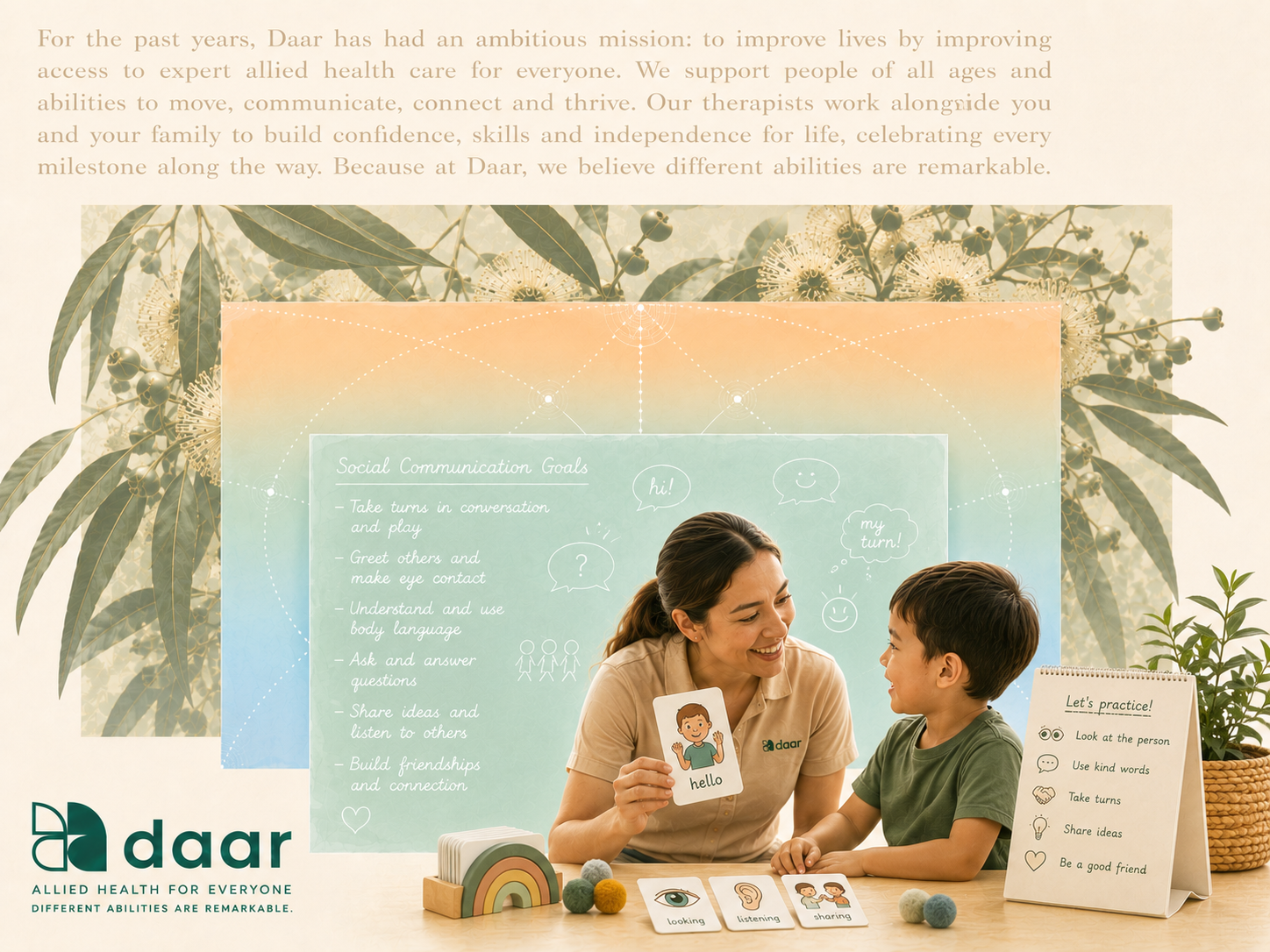
Speech therapy helps children build practical communication skills for the moments that matter most. Instead of working on isolated language tasks alone, therapy can focus on greetings, turn-taking, perspective-taking, and understanding what others mean in context.
A speech pathologist often tailors goals to the child’s social communication needs. Therapy may target both verbal and nonverbal communication, along with social understanding and flexible language use. The aim is effective communication, not perfect performance.
Speech therapy may support:
- Starting and maintaining conversation
- Understanding social cues and listener needs
- Repairing communication breakdowns
- Reading gestures, tone, and facial expression
- Using language for different purposes and settings
- Building confidence in peer and adult interactions
These supports are often strongest when they connect directly to school routines, play, and family life.
Common Speech Therapy Techniques Used
Speech therapy uses various techniques to build social communication skills. One-on-one sessions introduce new skills, while group sessions allow practice with peers in real-life situations.
Common methods include social scripts, skills groups, video instruction, comic strip conversations, and structured programs for conversation and interpretation. These approaches support pragmatic language, turn-taking, conflict resolution, understanding perspectives, figurative language, and inferencing.
For children with broader needs, therapy may include alternative communication tools like signs, pictures, or written supports. Effective intervention fosters language development and helps children use language successfully in social settings beyond therapy.
Collaboration With Families and Educators
Progress is stronger when therapy extends beyond the therapy room. Since children use communication skills in many settings, collaboration with families and educators is essential.
Parents, teachers, and specialists can share insights on what works, challenges, and where support is needed. This keeps goals practical and ensures everyone targets the same everyday skills—like joining a group, asking for help, or reading social cues.
Educators can encourage carryover by providing structured opportunities for conversation and peer interaction. Families can reinforce strategies during meals, playtime, and routines. When adults use consistent language and expectations across settings, children have more chances to practice and generalise their communication skills.
Evidence-Based Interventions
Evidence-based interventions for social communication disorder are chosen to match the child’s profile, age, and goals. They may target social understanding, conversation, peer participation, or language processing, depending on what is affecting daily function most.
Good planning also considers social communication benchmarks and the child’s natural environments. The goal is effective communication that carries into real life. That is why intervention often combines direct teaching, guided practice, and support from families, teachers, and peers.
Individual vs. Group Therapy Approaches
Different therapy approaches serve different purposes. Individual sessions are helpful when a child needs direct teaching, clear feedback, and a quieter space to learn a new communication strategy. Group sessions are valuable when the goal is practice with peers.
Both formats can strengthen social skills, but they do so in different ways. One-on-one therapy may focus on a child’s unique communication style, while group work supports flexibility, social competence, and problem-solving in shared activities.
A balanced plan may include:
- Individual therapy for targeted teaching and error correction
- Group therapy for turn-taking and conversation with peers
- Classroom-based practice for carryover in real routines
- Peer-supported activities for social learning in natural settings
Many children benefit most when these options are combined rather than treated as an either-or choice.
Social Skills Training Programs
Social skills training programs teach children how to interact effectively with others through direct instruction, modeling, role-play, and feedback. They cover social norms like greetings, sharing ideas, staying on topic, and responding appropriately to others’ feelings or comments. Some also address conflict resolution, self-control, and cooperation.
The best programs go beyond teaching rules by offering repeated practice with support. This is important because children with social communication challenges may know what to do but have trouble applying it in real situations. Regular practice helps make these skills more flexible and usable in daily life.
Using Play to Develop Social Communication
Play fosters social communication by providing natural opportunities to talk, listen, negotiate, and share attention. Through play, children practice joining activities, taking turns, following others’ ideas, and adapting to new situations.
Play also supports language development. In pretend play and group tasks, children use words and gestures to explain ideas, ask questions, and solve social challenges—revealing their understanding of emotions, rules, and perspectives.
For intervention, play offers a meaningful way for adults to teach without making interactions feel formal. It creates frequent, motivating opportunities in familiar settings. That’s why peer play and guided routines are often used to strengthen social communication in young children and school-age learners.
Strategies for Parents and Caregivers
Parents and caregivers can make a real difference in how children practice social communication skills each day. Support does not need to be complicated. Small, steady routines often work best.
Practical supports are most helpful when they happen during meals, play, errands, and family conversations. These everyday moments can build social competence over time. The next sections cover what you can do at home, how to encourage peer interaction, and when professional guidance may be the right next step.
Supporting Social Communication at Home
Home is one of the best places to support social communication because children have frequent, low-pressure chances to practice. Short conversations, shared routines, and simple games can all help. The goal is not to correct every mistake. It is to create opportunities for connection.
Parents can model clear use of language, show how to take turns, and help children notice another person’s point of view. This is especially useful when communication differences affect everyday routines or peer play. Home support can also strengthen language development and executive functioning.
Helpful strategies include:
- Model greetings, comments, and question forms during routines
- Pause to let your child respond or start an interaction
- Talk through feelings, intentions, and social choices
- Practice repair by rephrasing when messages are unclear
- Use play and shared activities to build back-and-forth exchange
These small actions can make practice feel natural and useful.
Encouraging Positive Peer Interactions
Positive peer interactions do not always happen on their own for children with social communication disorder. Many need support before they can join a group, stay in play, or manage the quick changes that happen in social settings.
Parents can help by choosing structured activities with clear roles and adult support nearby. Short play opportunities may work better than long, unplanned ones at first. A child may do best with one familiar peer before moving into larger groups. This gives time to practice social skills without too much pressure.
It also helps to prepare ahead. You can review what your child might say, how to ask to join, or what to do when a game changes. When support matches the child’s communication needs, peer time becomes less stressful and more successful. Repeated positive experiences can gradually build confidence and stronger relationships.
When to Seek Professional Help
You may want professional help if your child regularly struggles to join conversations, follow social rules, understand nonliteral language, or respond to other people in expected ways. These concerns matter most when they affect relationships, participation, or learning.
A speech pathologist can help determine whether the issue points to social communication disorder, language disorder, or another developmental profile. Getting support early can reduce frustration and guide families toward practical next steps. Assessment should look at real-life communication, not isolated tasks alone.
It is also worth seeking help if teachers, caregivers, or other adults notice similar concerns across settings. Consistent patterns are important. Families who want further information can review a practice portal or speak directly with a qualified professional. You do not need to wait for problems to become severe before asking questions.
Navigating School and Community Support in Australia
Children with social communication disorder often need support beyond therapy. School support and community resources can make daily participation easier and more successful. The right accommodations help reduce barriers and give children better access to learning and peer interaction.
Support works best when it reflects real communication needs across classrooms, activities, and public spaces. In Australia, families often need to understand both school-based help and broader community options. The next sections break those areas down clearly.
School-Based Services and Accommodations
School is where many social communication demands become obvious. Students are expected to follow group discussion, adjust language use for teachers and peers, understand classroom routines, and respond to social norms that shift throughout the day. For a child with social communication disorder, these tasks may be harder than they look.
School services can include speech-language support, classroom strategies, and coordinated planning with teachers and families. The goal is to improve participation, not just test performance. Helpful accommodations make expectations clearer and give students more support in real communication moments.
Examples of useful accommodations include:
- Visual supports for conversation rules or classroom routines
- Structured peer activities with adult guidance
- Extra support for storytelling, discussion, and group work
- Clear teaching of hidden social norms and expectations
When supports are practical and consistent, children can take part more confidently in school life.
Accessing Community Programs and Resources
Community programs and resources can support families beyond school and therapy. Options may include conversation groups, social skills classes, life skills workshops, and programs run by speech pathologists or psychologists. These offer extra practice in real-life settings.
Some children may also need support with alternative communication, hearing, or co-occurring language issues. Available community resources vary by location, so families should ask schools, local providers, or health services about nearby options. The best programs align with the child’s daily needs.
Parents searching online can find helpful information from professional organisations and practice portals about social communication challenges, assessment, and interventions. While these resources don’t replace personalised care, they help families understand key terms, prepare questions, and seek appropriate support.
Conclusion
In conclusion, understanding Social Communication Disorder (SCD) is crucial for providing the necessary support to those affected. By recognising the signs and symptoms, diagnosing effectively, and implementing evidence-based interventions such as speech therapy and social skills training, we can foster better communication in children and adults alike. Parents and caregivers play a vital role in encouraging positive interactions at home and advocating for resources within schools and communities. Remember, reaching out for professional help when needed can make a significant difference.
If you're looking for personalised guidance or resources, don’t hesitate to get in touch for a consultation or call daar at 02 9133 2500.
Frequently Asked Questions
What is the difference between social communication disorder and autism?
Social communication disorder involves persistent difficulty using communication appropriately in social contexts. Autism spectrum disorder includes those same social challenges but also requires restricted and repetitive behaviours under diagnostic criteria. A child may also have language impairment, but social communication disorder is considered only after autism spectrum disorder has been ruled out.
Can children outgrow social communication disorder with intervention?
Children can make meaningful progress with intervention, especially when support starts early and fits daily life. Many improve their social communication skills and language development over time. Still, growth is often gradual, so responsive practice across home, school, and therapy is important for lasting change.
Are there online resources for parents supporting children with social communication challenges?
Yes. Parents can use online resources from professional organisations to get further information about social communication disorder, assessment, and intervention. A practice portal page can be a helpful starting point for understanding social communication difficulties, learning key terms, and preparing questions before meeting with a professional.
.svg)




.svg)