
.png?width=48&height=48&name=Group%201%20(3).png)























12 March, 2026

Essential Autism Parenting Tips Every Caregiver Should Know

Key Highlights
- Parenting an autistic child involves creating a supportive home environment with clear routines and sensory-friendly adaptations.
- Effective communication relies on understanding nonverbal cues and using visual supports to enhance clarity for your child.
- Positive parenting strategies, including specific praise and rewarding good behavior, can significantly improve your child’s development.
- Teaching new skills, from everyday tasks to problem-solving, is best done in simple, step-by-step increments to build confidence.
- Joining support groups and practicing self-care are vital for your own mental health as you navigate this journey.
- This guide offers practical tips to help you foster your child's emotional well-being and independence.
Introduction
Receiving a diagnosis that your child has Autism Spectrum Disorder (ASD), a neurodevelopmental disorder, can feel overwhelming. As caregivers of children with autism, you might be wondering about the first signs and the best ways to support your child’s development and manage daily challenges. The purposes of this article are to provide practical, actionable guidance to make your journey easier. From building a supportive home to fostering new skills, these tips are designed to enhance your child's well-being and your own mental health, empowering you to navigate parenting with confidence.
Building a Supportive Home Environment
Creating a nurturing home base is fundamental for an autistic child. This means designing a space where they feel safe, understood, and secure. A supportive environment considers your child’s individual needs, particularly their sensory needs, and provides predictability to reduce anxiety, as well as the intensity of supports necessary for their development.
Establishing this foundation can involve creating a quiet space for them to retreat to and structuring daily activities. The goal is to build a consistent and loving home that reinforces learning and supports their mental health, especially considering autistic children may exhibit limited interests. New parents of autistic children should avoid forcing social interactions, minimizing or ignoring their child's sensory needs, or creating an unpredictable environment, as these can increase anxiety and stress. The following sections will explore how to create comforting routines and adapt your home for sensory sensitivities.
Creating Daily Routines for Comfort and Security
Children on the autism spectrum often thrive with structure, as routines provide comfort and security. Predictability reduces stress and anxiety, making transitions smoother and minimizing challenging behaviors. A consistent schedule helps your child know what to expect, especially for those who require the lowest amount of support.
For example, a simple dinner routine can be part of a larger schedule including playtime, bath, and bedtime. Visual schedules clarify what comes next, and preparing your child for routine changes by adjusting the schedule can help. Using a "first/then" approach also makes transitions easier.
Examples of routine steps:
- First, finish lunch, then go outside.
- In five minutes, it’s time for a bath.
- First, clean up toys, then go to the park.
- First teeth, then story time.
Adapting Your Home for Sensory Needs
Many autistic children experience the world differently due to sensory sensitivities and may exhibit repetitive behaviors. They may be hypersensitive to light, sound, or touch, while others might be under-sensitive. Understanding these sensory needs is crucial for creating a comfortable home. Pay attention to what environmental factors trigger stress and what brings calm.
A key adaptation is to create a quiet space or a "home safety zone" where your child can go to relax and feel secure when overwhelmed. This private area allows them to decompress without pressure. You can use visual cues, like colored tape, to mark off-limits areas or label items with pictures to provide clarity.
Consider these adjustments to cater to your child's needs:
- Use dimmer lighting if your child is sensitive to bright lights.
- Provide noise-canceling headphones for sound sensitivity.
- Offer a variety of textures in toys and blankets.
- Incorporate your child’s interests into their personal space.
Effective Communication Strategies with Your Autistic Child
Connecting with your autistic child requires creative and patient communication strategies. While some children use verbal communication, many rely heavily on nonverbal communication to express their needs and feelings. It's your job to learn their unique language, which can involve paying close attention to their gestures, sounds, and facial expressions. Additionally, you can read tips from the National Autistic Society to enhance your communication methods.
By embracing different ways to connect, you can build a stronger bond and reduce frustration for both of you. Using visual supports and other alternative tools can bridge communication gaps and improve understanding, but remember, this does not act as an endorsement of any resource. The following sections offer tips on how to encourage all forms of communication and use these helpful aids effectively.
Encouraging Verbal and Nonverbal Communication
Fostering communication with neurodivergent children means recognizing all their attempts to connect, verbal or nonverbal. By observing your child’s cues—when they're tired, hungry, or want something—you can reduce frustration and prevent meltdowns while being mindful of the symptoms of autism.
Offer specific praise when your child acts appropriately or learns a new skill, like saying, "I love how you shared your toy." This positive reinforcement encourages repeated behavior. Teaching them to recognize and label feelings helps them express emotions constructively.
To encourage communication:
- Notice their sounds, facial expressions, and gestures.
- Praise specific positive actions.
- Enjoy relaxed playtime together.
- Model how to identify and name emotions.
Using Visual Supports and Alternative Tools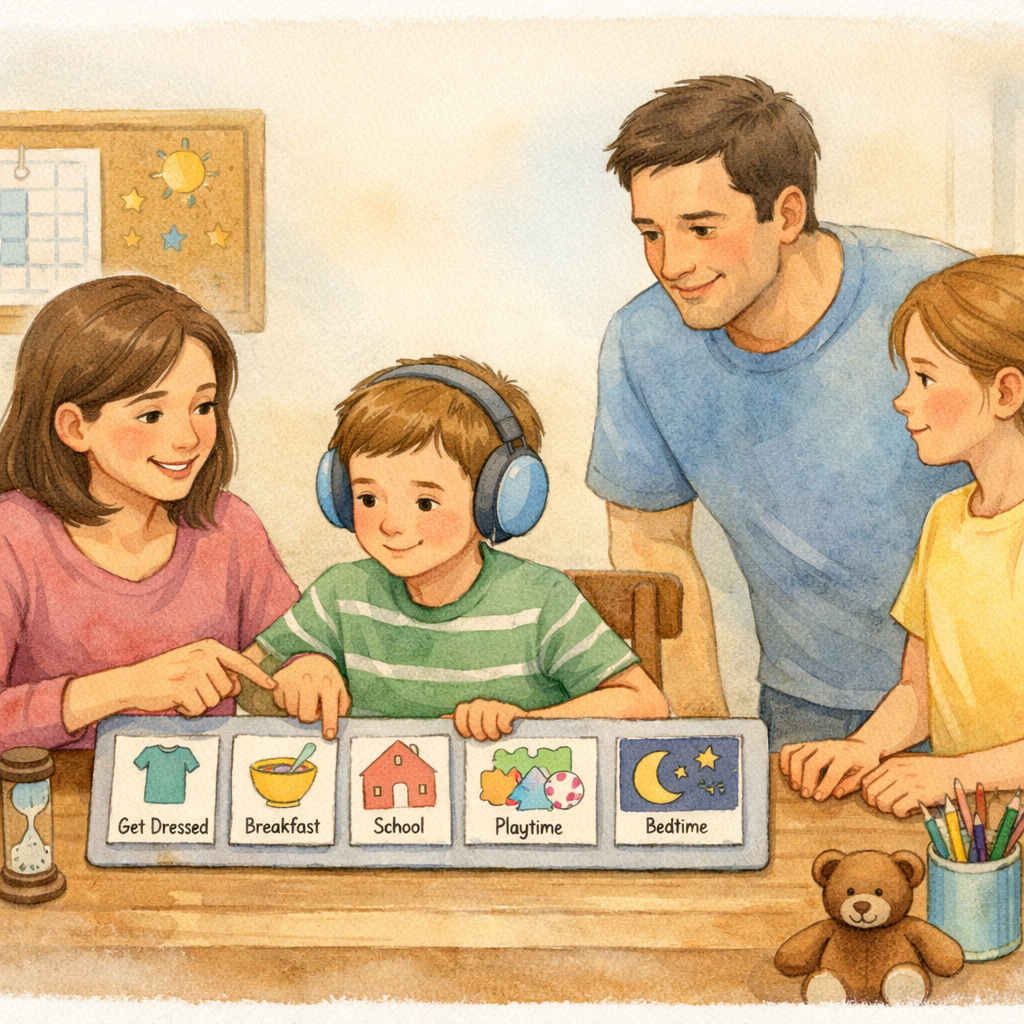
Many children with developmental disabilities and additional needs find it easier to think in pictures than to understand verbal instructions. Visual supports and alternative tools can greatly improve communication and help teach new skills by breaking tasks into clear steps.
Work with educational professionals to create personalized visual aids, such as picture cards for routines, behavior charts, or dry-erase 'first/then' boards as part of a larger routine. The key is to match tools to your child’s learning style.
Examples of visual aids include:
- Picture schedules for daily routines
- "First/then" boards showing tasks and rewards
- Picture cards to communicate needs
- Timers for smooth activity transitions
- Written lists for children who read
Fostering Emotional Well-being and Social Skills
Supporting your child’s emotional well-being and helping them develop social skills is a critical part of parenting in their daily life. Autistic children often experience anxiety and can struggle to understand and manage their emotions. Your role is to provide a safe space for them to express their feelings and guide them toward positive social interactions.
Creating opportunities for them to practice social skills in a supportive setting can foster a positive relationship, making a big difference. This might involve joining support groups or arranging playdates with understanding peers. Below, we'll explore ways to help your child manage their emotions and build meaningful friendships.
Helping Your Child Manage Emotions and Anxiety
Big feelings like frustration and anxiety can be overwhelming for an autistic child, sometimes leading to meltdowns or aggressive behavior. A key strategy is to teach them how to recognize and manage their emotions when they are calm, not in the middle of a crisis. This proactive approach helps build their self-regulation skills over time and can go a long way in fostering emotional development.
You can model healthy coping mechanisms, like taking deep breaths or asking for a break. When you remain calm during a challenging moment, you help your child feel safe and show them how to handle stress. Referencing the statistical manual of mental disorders can provide additional strategies. Using positive reinforcement to praise their efforts to manage emotions can boost their confidence and mental health.
Here are some practical tips:
- Teach your child to recognize and label their feelings.
- Practice calming techniques together, such as slow breathing.
- Create a quiet place they can go to calm down.
- Respond consistently to challenging behaviors with a calm and simple approach.
Guiding Positive Social Interactions and Friendships
Developing friendships and navigating positive social interactions can be challenging for a child with a developmental disability, as autism presents unique challenges. You can help by creating structured opportunities for them to practice their social skills in a comfortable environment. Building on your child’s individual needs and interests is the best way to start.
Engaging in pretend games or activities they enjoy can make social learning feel fun rather than like work. For example, you can practice taking turns during a board game or sharing toys. Praise their efforts, no matter how small, to build their confidence in social settings.
Use role-playing to practice social scenarios, like greeting someone and enjoying everyday moments together.
- Start with one-on-one playdates before moving to larger groups.
- Use role-playing to practice social scenarios, like greeting someone.
- Teach them to recognize social cues through stories or games.
- Focus on their interests to help them connect with like-minded peers.
Nurturing Independence and Life Skills
Teaching life skills is essential for nurturing your autistic toddler’s confidence and independence. Breaking down everyday tasks into small, manageable parts makes learning less overwhelming. The goal is to gradually reduce your assistance until they can complete the task on their own.
This step-by-step approach not only teaches practical skills but also enhances their problem-solving abilities. As they master new skills, you will see their self-esteem grow. The following sections detail how to teach daily tasks and encourage decision-making, setting them up for greater autonomy in the future.
Teaching Everyday Tasks Step-by-Step
Learning new skills can be a challenge for an autistic child, but breaking complex activities into simple steps can make a huge difference. One effective strategy is "backward chaining," where you help your autistic child with all but the final step of a task. They complete the last step on their own, and you offer plenty of praise, which positively influences your autistic child’s behavior.
The next time, they complete the last two steps, and so on, gradually working backward until they can do the entire task independently without their parent’s help. This method builds confidence and makes learning new ways of doing things feel less daunting. Remember to be patient and celebrate every small win along the way.
You can break down tasks like getting dressed into simple steps:
- Pull the shirt down over the tummy (final step).
- Pull the shirt over the head.
- Put the other arm through a sleeve.
- Put one arm through a sleeve (first step).
Encouraging Decision-Making and Problem Solving

Fostering independence means giving your child chances to make choices and solve problems, building their critical thinking and confidence. Start with simple decisions and include their interests to keep them engaged—like challenging a block lover to build block towers and a stable tower. This empowers them and strengthens your relationship.
To encourage these skills:
- Offer two snack or outfit options (e.g., "Apple or banana?").
- Ask for their input on weekend plans.
- Let them try solving simple problems before helping.
- Praise their efforts in decision-making, even if imperfect.
Conclusion
Parenting an autistic child is both rewarding and challenging. By creating a supportive home, using effective communication, and fostering emotional well-being, you help your child thrive. While there’s no magic fix, patience and adaptability are key to nurturing their independence and life skills. Every child is unique, so find what works best for your family for meaningful growth and connection.
For personalized strategies, consider a consultation or call daar at 02 9133 2500 with autism parenting specialists. Your love and support shape your child's future.
Frequently Asked Questions
What common challenges do parents in Australia face with autism family support?
Parents in Australia often face challenges in accessing timely and affordable comprehensive support tailored to their child's specific needs, as outlined by the American Psychiatric Association. Navigating the NDIS, finding qualified educational professionals, and securing services that align with their child's range of interests can be difficult, impacting the family's overall mental health and well-being.
Which parenting approach works best for autistic children?
There is no one-size-fits-all answer, but positive parenting is highly effective. This approach focuses on your child’s individual needs and strengths, using practical tips and reinforcement to encourage good behavior. The best strategy is tailored to your child’s unique personality and levels of severity, always with a focus on their mental health and the different therapies available.
How can parents balance caring for their child with their own well-being?
Balancing caregiving with self-care is crucial for parents of autistic children, especially during difficult moments. Joining support groups, seeking respite care, and considering a flexible online course for parenting strategies can provide comprehensive support. Prioritizing your own mental health ensures you have the strength and patience to be the best parent you can be.
My son has autism disorder. How can I cure him?
There is no cure for autism, but effective autism parenting tips focus on understanding and supporting your child. Foster communication, create a structured environment, and seek professional guidance. Emphasize strengths and interests, while promoting social skills. Patience, love, and tailored strategies can significantly improve your child's quality of life.
.svg)




.svg)