
.png?width=48&height=48&name=Group%201%20(3).png)
























Liam (name changed for privacy) is a sweet, highly observant two-and-a-half-year-old boy who loves water play, spinning toys, and being pushed on the swings. While Liam was incredibly affectionate with his parents, they noticed that he was missing several key early development milestones.
Approaching his third birthday, Liam was entirely non-verbal. He struggled to point to objects he desired, make eye contact, or engage in reciprocal play. When his needs weren't met—often simply because his parents couldn't decipher what he wanted—Liam would drop to the floor, scream, and occasionally resort to biting himself or others. Exhausted and worried about his transition into a new childcare setting, Liam's parents reached out to the early intervention team at daar to determine if Applied Behaviour Analysis (ABA) therapy would be the right fit for their toddler.
The Challenge
For toddlers, the inability to communicate is an overwhelming barrier that creates a continuous cycle of frustration. For Liam, this barrier severely impacted his daily functioning and his family’s well-being:
- At Home: Basic routines, such as meal times or getting dressed, were extremely unpredictable. Without the ability to use words or gestures, Liam would become intensely distressed if given the wrong snack or if his routine changed unexpectedly. His parents felt like they were constantly "walking on eggshells," attempting to anticipate his needs to prevent severe tantrums.
- At Childcare: Liam’s transition into early learning was rocky. Unable to ask for a turn with a toy, he would instinctively grab items from other children or bite when overwhelmed by the noise of the classroom. Consequently, educators had to shadow him constantly, and he was missing out on the foundational benefits of parallel and associative play with his peers.
Liam required an early intervention strategy that was gentle, highly motivating, and focused on making communication easier and more rewarding than his challenging behaviors.
daar Therapy Approach
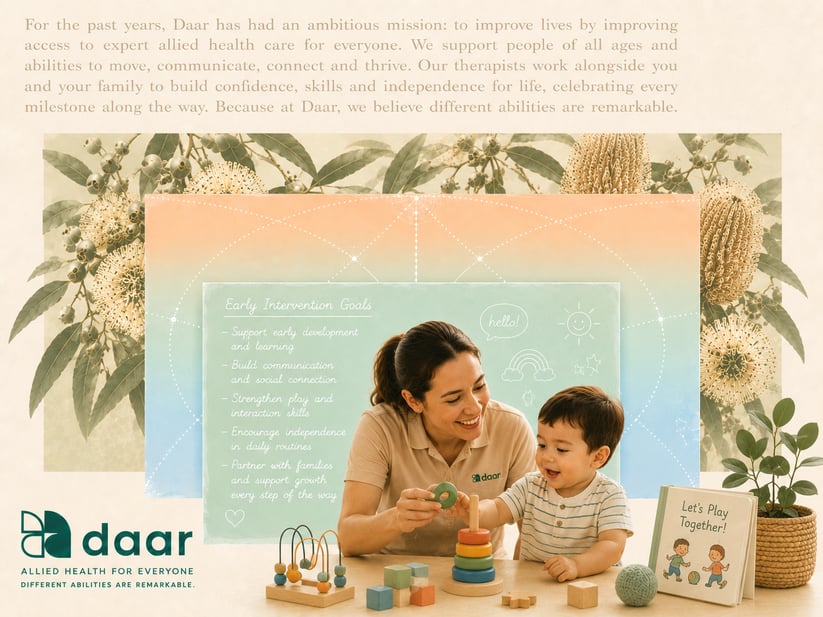
At daar, we understand that early intervention for toddlers must be natural, engaging, and play-based. Traditional, rigid teaching environments are ineffective for a two-year-old. Instead, we designed a comprehensive, child-led program utilizing play-based Applied Behaviour Analysis (ABA), seamlessly integrated with functional communication strategies.
Our highly individualized approach focused on teaching Liam through the things he loved most:
- Natural Environment Teaching (NET): The core of our behaviour therapy for children was based on NET. Our clinicians got on the floor with Liam, using his favorite spinning toys and water activities to naturally motivate him. If he wanted the top to spin, the therapist would gently pause and wait for a target behavior—such as eye contact or a basic sound approximation—before continuing the fun.
- Targeted Speech Therapy Integration: Working closely with a daar speech pathologist, we introduced early communication tools. We began with simple baby sign language and picture exchange communication. The goal was to give Liam an immediate, functional voice.
- Positive Behaviour Support Guidelines: Every time Liam attempted to communicate using a sign, picture, or sound, he was excessively rewarded with his favorite sensory play. By strictly following positive behaviour support principles, we ensured that functional communication resulted in a much faster, easier reward than throwing a tantrum or biting.
- Childcare Integration & Socialised Behaviour Therapy: To ensure Liam succeeded outside the clinic, our behaviour practitioners spent time at his childcare center. Through targeted socialised behaviour therapy, we trained his early childhood educators to use his visual communication tools and modeled how to prompt him for a "turn" during peer play, creating a consistent, supportive environment.
.svg)

Results & Progress
Within six months of engaging in play-based ABA therapy, Liam's world opened up significantly. By focusing on connection, motivation, and positive reinforcement, the therapy provided him with a predictable framework for his daily life.
At home, the intense meltdowns associated with meals and routines drastically decreased as Liam learned to use simple signs for "more," "all done," and "help." At childcare, the biting incidents completely ceased. Instead of grabbing toys, Liam began to tolerate parallel play, occasionally handing a picture card to his educator to request a specific activity.
Reduction in distress-related tantrums.
Elimination of physical aggression toward peers.
Functional Communication

Key Outcomes
Liam’s progress underscores the unparalleled value of early intervention. When ABA therapy is play-based and tailored to a toddler's unique interests, the outcomes can be life-changing for the entire family:
- Bridging the Communication Gap: Providing Liam with functional ways to express his needs eliminated the root cause of his frustration, paving the way for safer, happier interactions.
- Safe and Successful Socialization: The elimination of aggressive behaviors like biting allowed Liam to remain in his mainstream childcare setting, setting him up for long-term social success.
- Empowered Families: Through parent coaching, Liam’s family learned how to turn everyday routines (like bath time or snack time) into natural, stress-free learning opportunities.
- Foundational Readiness: By addressing these developmental gaps at age two, Liam is now on a much stronger, more resilient trajectory as he approaches preschool.
Conclusion
For parents of toddlers exhibiting developmental delays, severe tantrums, or communication barriers, wondering what the right step is can be overwhelming. Modern, play-based ABA therapy provides a nurturing, highly effective framework to support early childhood development. By combining natural environment teaching with robust speech therapy and positive behaviour support, toddlers can learn to navigate their world with confidence, dramatically reducing frustration for both the child and the caregivers.
As Liam’s mother deeply expressed:
"Before starting ABA at daar, we were completely lost and heartbroken. We couldn't understand what Liam needed, and his meltdowns were taking over our lives. The team didn't try to change who he was; they just got down on the floor, played with his favorite toys, and slowly taught him how to tell us what he wanted. The day he signed 'help' to me instead of throwing himself on the floor, I broke down in tears. daar gave our little boy his voice and gave us our family back."
Are you concerned about your toddler’s communication, social milestones, or challenging behaviours? Early intervention can provide the compassionate, structured support your family needs.
Take the first step toward unlocking your toddler’s potential.
Reach out to the expert allied health practitioners at daar today to discuss how our play-based ABA and early intervention programs can support your child's unique journey. Call us at 02 9133 2500 or visit our website to secure your initial consultation!


Get access to quality, Efficient, and professional care.
Request a call to find out how daar can help you achieve your health goals.

Leading source of information for allied health news, studies and resources.

We support you to be self-determined and independent, giving you the control and freedom to achieve your individual goals.

We provide superior quality, client-centric and innovative treatment to support you to realise your full potential.
.svg)




.svg)