One hour of therapy, five different item numbers
Most people picture an NDIS therapy budget as a simple sum: the hourly rate multiplied by the number
of sessions. The schedule does not work that way. A single therapy hour can be claimed under several
different support item numbers, and only one of them is the session itself.
Alongside the direct service code, most therapy supports have companion codes for
telehealth, non-face-to-face work (such as report writing),
provider travel, NDIA-requested reports and
short-notice cancellations. Each has its own price limit, and each draws on the same
plan budget.
We pulled the price limits for every one of these codes from the 2026–27 NDIS Pricing Schedule.
Two patterns hold across every therapy discipline.
1. A cancellation can claim the same as attending
This is the one that surprises people. The price limit for a short-notice cancellation
is identical to the price limit for the session itself. So is report writing, and so is an NDIA-requested
report.
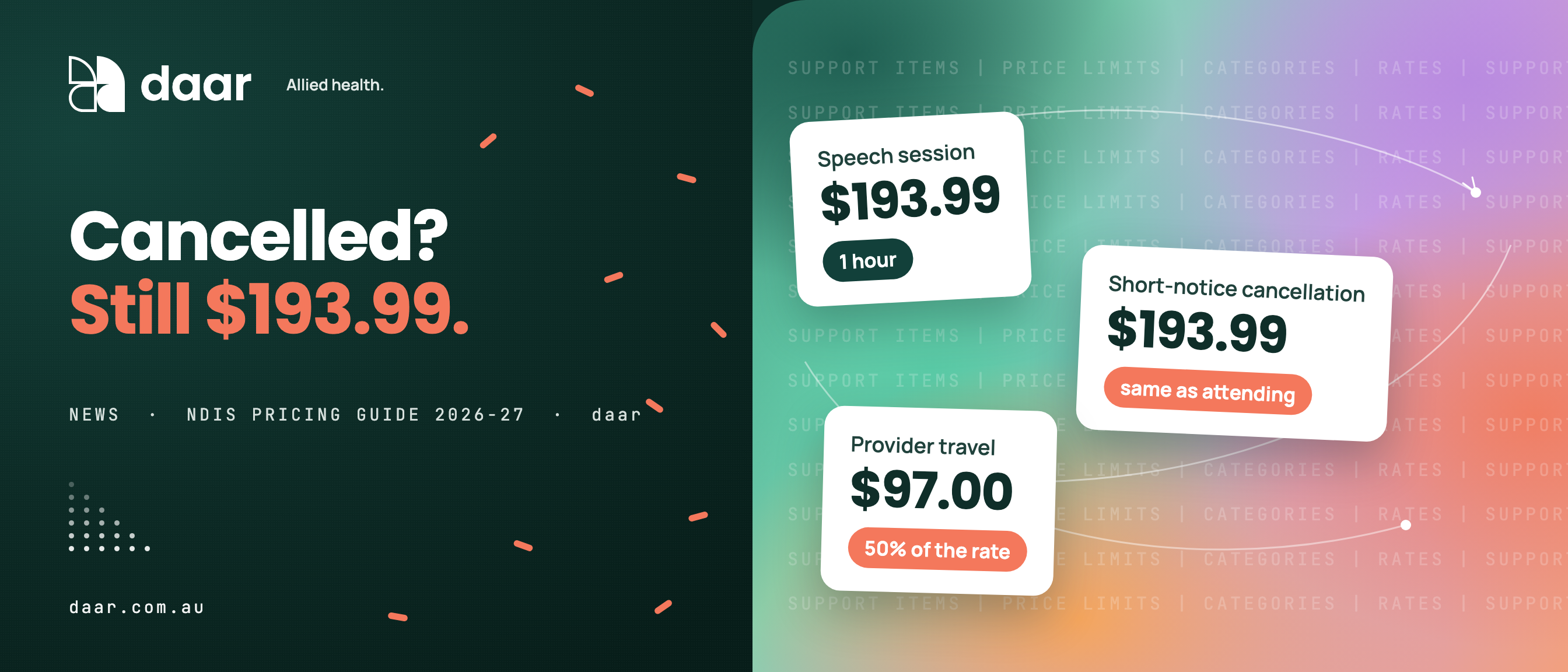
A cancelled speech pathology session can claim $193.99 — exactly what the session
would have claimed. For psychology, it is $252.99.
2. Provider travel is capped at half the hourly rate
Provider travel is the exception. Across every discipline we checked, its hourly price limit is
exactly 50% of the direct-service limit.
The 2026–27 price limits, side by side
National price limits per hour, effective 1 July 2026:
| Support | Session | Telehealth | Cancellation |
Report writing | Provider travel |
| Speech pathology | $193.99 | $193.99 | $193.99 | $193.99 | $97.00 |
| Occupational therapy | $193.99 | $193.99 | $193.99 | $193.99 | $97.00 |
| Psychology | $252.99 | $252.99 | $252.99 | $252.99 | $126.50 |
| Physiotherapy | $183.99 | $183.99 | $183.99 | $183.99 | $92.00 |
| Exercise physiology | $161.99 | $161.99 | $161.99 | $161.99 | $81.00 |
These are maximum price limits, not automatic charges. A provider cannot claim more than the
limit, but whether a particular claim can be made at all — and on what notice — is governed by
the NDIS Pricing Arrangements and your service agreement.
What this means in practice
Two plans funding the same number of sessions can run out at very different times, depending on how
much non-session activity is claimed against them. If your therapy involves detailed reporting, or your
therapist travels to a home, school or workplace, that activity draws on the same budget as the sessions.
Some practical steps:
- Ask what gets claimed. Your service agreement should set out whether travel,
report writing and cancellations will be claimed, and on what terms.
- Check the notice period. Short-notice cancellation rules are set by the NDIS, and
the price limit is the same as the session — so late changes have a real budget cost.
- Factor in travel. Home, school and workplace visits are valuable, but travel is
claimable at up to half the hourly rate.
- Consider telehealth where it suits. The session limit is the same, but there is no
travel to claim.
Check any support item yourself
Figures are national price limits from the NDIS Pricing Schedule 2026–27, effective 1 July 2026.
Remote and very remote limits are higher. For the rules on when each claim type can be made, see the
NDIS Pricing Arrangements and Price Limits. This is general information,
not financial advice — check your service agreement and plan.

.png?width=48&height=48&name=Group%201%20(3).png)
























.svg)




.svg)