The same budget does not buy the same support everywhere
The NDIS sets three price limits for most supports: National, Remote
and Very Remote. It is one of the least discussed parts of the schedule, and one of the
most consequential if you live outside a major centre.
We checked all 596 hourly supports in the 2026–27 schedule. The pattern is
completely uniform, with no exceptions:
- Remote price limits are 140% of the national limit — a 40% loading.
- Very Remote price limits are 150% of the national limit — a 50% loading.
This is not a therapy quirk. It applies to support work as well: an hour of standard weekday self-care
assistance is $73.58 nationally, $103.01 remote and
$110.37 very remote.
What a $15,000 plan funds, by location
The loading is a percentage, so the effect compounds against a fixed budget. Here is what the same
$15,000 therapy budget funds at each price limit, based on one-hour sessions:
| Support | National | Remote | Very Remote | Sessions lost |
|---|
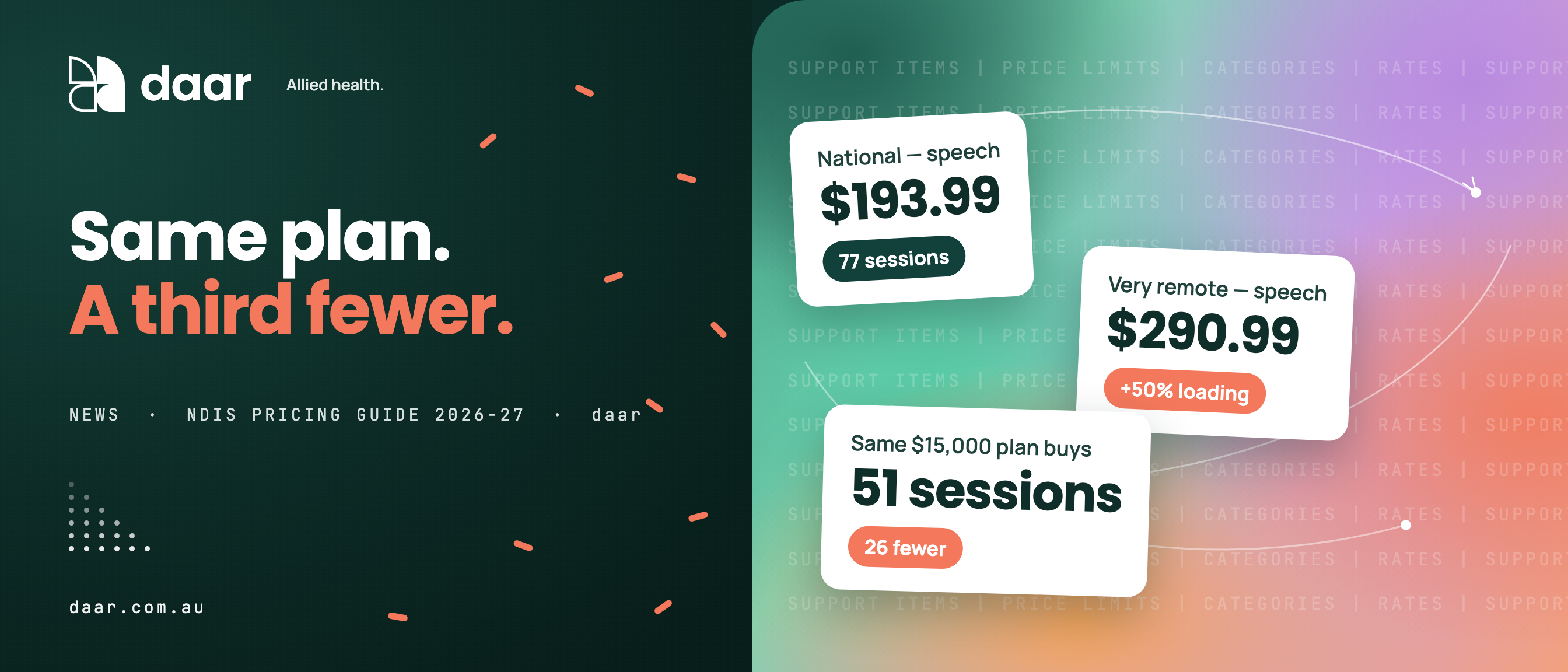
| Speech pathology | 77 sessions
($193.99) | 55 sessions
($271.59) | 51 sessions
($290.99) | 26 |
| Occupational therapy | 77 sessions
($193.99) | 55 sessions
($271.59) | 51 sessions
($290.99) | 26 |
| Psychology | 59 sessions
($252.99) | 42 sessions
($354.19) | 39 sessions
($379.49) | 20 |
| Physiotherapy | 81 sessions
($183.99) | 58 sessions
($257.59) | 54 sessions
($275.99) | 27 |
| Exercise physiology | 92 sessions
($161.99) | 66 sessions
($226.79) | 61 sessions
($242.99) | 31 |
The arithmetic is consistent across every discipline: at the very remote limit, a fixed budget funds
about a third fewer hours than the same budget at the national limit. For speech
pathology, that is the difference between 77 sessions and 51 — 26 sessions, or most of a school year
of weekly therapy.
Why the loading exists
It is worth being clear about what these loadings are for. Delivering supports over distance genuinely
costs more — travel time, thinner workforce, higher cost of doing business. The loading is there to
make it viable for providers to work in remote and very remote communities at all. Without it, the
practical problem would not be price, it would be finding anyone to deliver the service.
So a higher price limit is not, in itself, a participant being short-changed. What matters is whether
the plan budget reflects the price limits that apply where you live. That is a question for your plan,
not the schedule — and it is worth raising directly at a planning meeting or reassessment.
Two things worth knowing
Telehealth does not lower the limit. We checked: the telehealth price limit carries the
same loading as an in-person session — $271.59 remote for speech pathology, the same as direct
service. What telehealth can avoid is a separate provider travel claim on top, since travel is claimable
against its own item number at up to half the hourly rate.
The loading follows the support location. Which limit applies depends on where the
support is delivered, not where the provider is based. If you are unsure which applies to you, the
NDIS remoteness classifications are the place to check.
Check the limits that apply to you
Figures are price limits from the NDIS Pricing Schedule 2026–27, effective 1 July 2026. Session
counts assume one-hour sessions at the price limit and a $15,000 budget, and are rounded down. For the rules
on remoteness classifications and how limits apply, see the
NDIS Pricing Arrangements and Price Limits. This is general information,
not financial advice.

.png?width=48&height=48&name=Group%201%20(3).png)
























.svg)




.svg)