
.png?width=48&height=48&name=Group%201%20(3).png)























5 December, 2025

Behaviour goals are one of the most powerful parts of your child’s NDIS plan—when they’re written clearly and tailored to their stage of development. Strong goals guide therapy, ensure funding aligns with your child’s needs, and help measure real progress at home, school, and in the community.
This guide breaks down age-appropriate NDIS behaviour goals with practical examples families can use when preparing for planning meetings or updating their plan.
Why Good Behaviour Goals Matter in the NDIS

Effective behaviour goals should be:
-
Measurable – so progress is clear
-
Functional – supporting daily life and participation
-
Strength-based – focusing on building skills
-
Individualised – tailored to your child’s needs, age, and environment
When behaviour goals are vague (e.g., “improve behaviour”), they’re hard to implement and even harder to fund.
When they’re clear and functional, they guide therapy, reduce stress for families, and create real improvement.
A helpful starting point is understanding why behaviour occurs, which you can learn more about through DAAR’s resource on functional behaviour assessment.
Behaviour Goal Examples for Toddlers (1–3 Years)
At this age, goals focus on communication, emotional expression, and reducing frustration.
Example NDIS Behaviour Goals
-
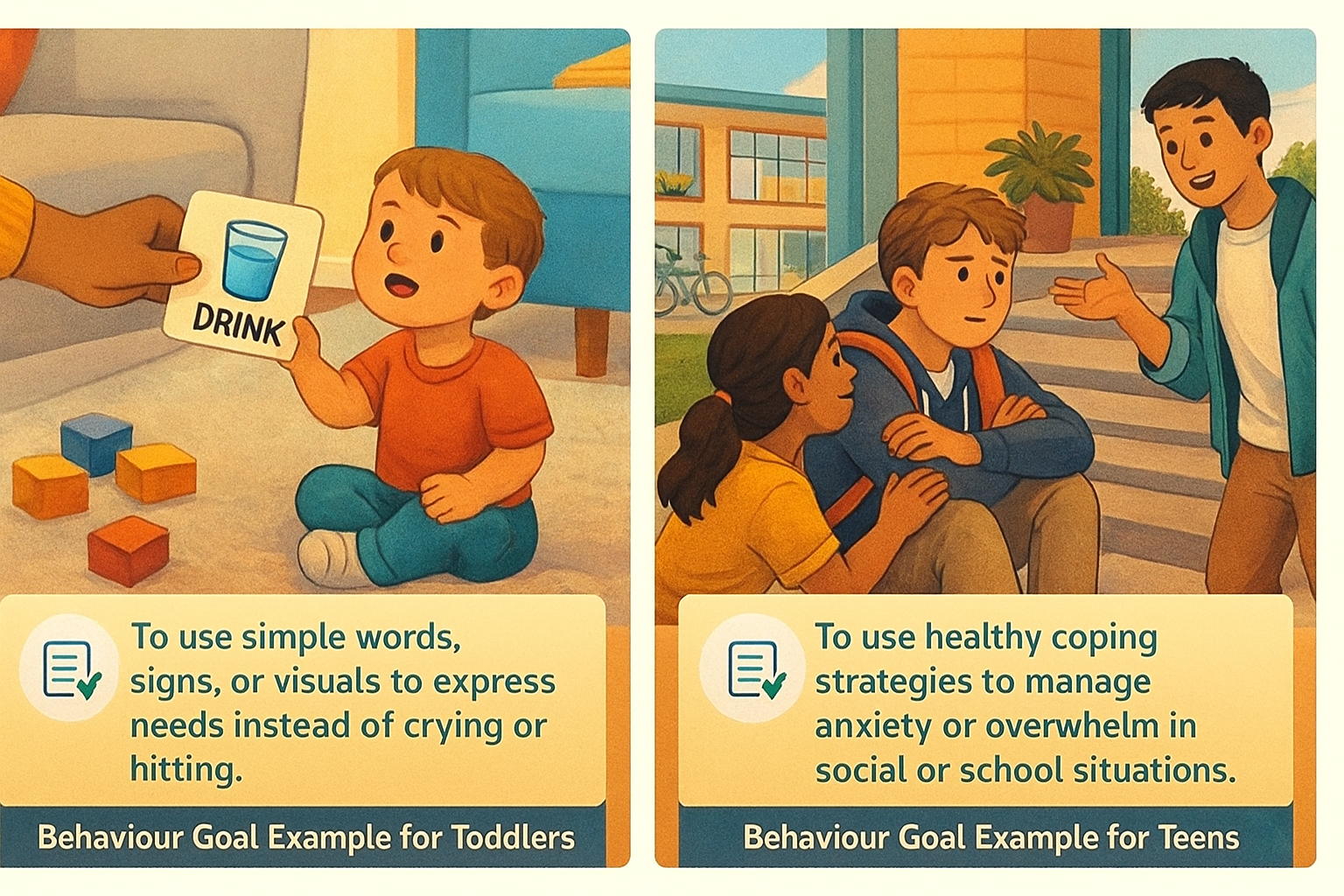
“To use simple words, signs, or visuals to express needs instead of crying or hitting.”
-
“To follow a simple routine with one to two steps during daily tasks like mealtime or pack-away.”
-
“To tolerate short transitions (e.g., moving from play to nappy change) using visual supports.”
-
“To use basic calming strategies (e.g., deep breaths, sensory tools) with support.”
Toddlers often need early emotional and communication foundations. Behaviour practitioners can help families understand triggers and create strategies, as explained through specialised behaviour support for kids.
Behaviour Goal Examples for Preschoolers (3–5 Years)
This age group is preparing for kindergarten, so goals are more structured and social.
Example NDIS Behaviour Goals
-
“To use visual supports to transition between activities with fewer emotional outbursts.”
-
“To take turns during play or group activities for up to two minutes with prompting.”
-
“To express big emotions using words or visuals instead of hitting, yelling, or running away.”
-
“To follow a three-step instruction during play or learning activities.”
-
“To remain seated during group time for increasing intervals using a sensory strategy.”
Families in this age group often benefit from personalised behaviour planning.
You can learn how these plans are developed through how PBS strategies are personalised.
Behaviour Goal Examples for Early Primary (5–8 Years)
Children in early schooling begin to navigate more complex social, sensory, and learning environments.
Example NDIS Behaviour Goals
-
“To use self-regulation strategies (break card, breathing, sensory tools) when overwhelmed in the classroom.”
-
“To follow multi-step instructions during learning activities with minimal prompting.”
-
“To improve social problem-solving by identifying feelings and choosing appropriate responses.”
-
“To reduce meltdowns during homework or structured tasks by using a visual schedule.”
-
“To stay in supervised areas at school and home, using a safety plan.”
Behaviour support at this age often focuses on participation and school engagement.
If families need guidance choosing suitable supports, refer them to information on positive behaviour support and early intervention services.
Behaviour Goal Examples for Later Primary (8–12 Years)
This stage brings increased academic expectations, peer relationships, and growing independence.
Example NDIS Behaviour Goals
-
“To use conflict-resolution strategies during peer interactions with adult support.”
-
“To manage frustration during homework or group projects using self-regulation tools.”
-
“To identify early signs of overwhelm and ask for a break appropriately.”
-
“To independently start and complete a routine (e.g., getting ready for school) using a checklist.”
-
“To reduce disruptive behaviours during class by recognising triggers and using coping strategies.”
Many children in this age group benefit from joint speech and behaviour support, particularly for emotional expression.
Use internal links like parent training in behaviour support where relevant in your broader content ecosystem.
Behaviour Goal Examples for Teens (12–18 Years)
Teenagers require goals that support identity, autonomy, emotional regulation, and community participation.
Example NDIS Behaviour Goals
-
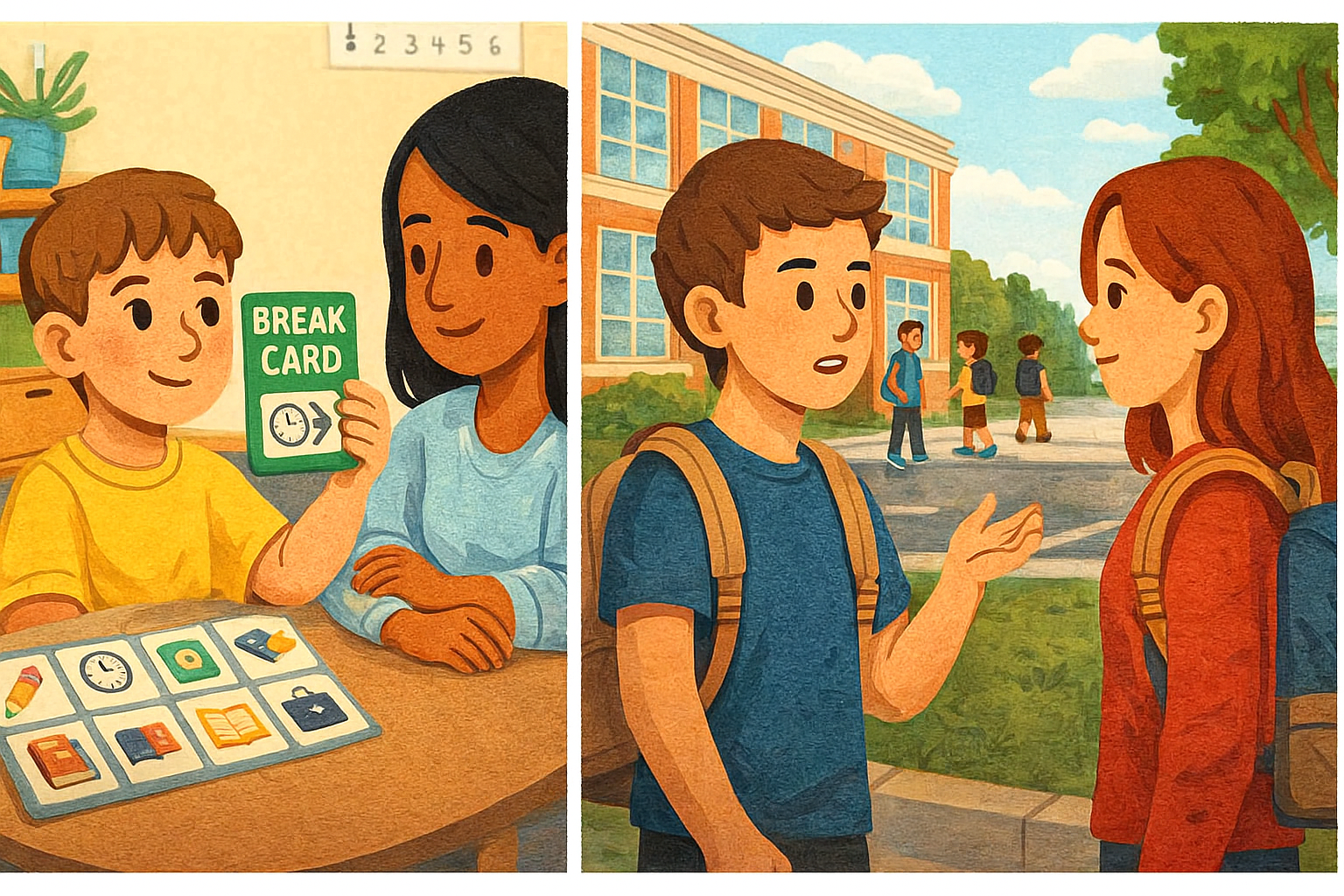
“To use healthy coping strategies to manage anxiety or overwhelm in social or school situations.”
-
“To plan and follow a morning routine independently using a visual or digital schedule.”
-
“To practise assertive communication when negotiating boundaries with peers or adults.”
-
“To build decision-making skills by identifying options and choosing safe, appropriate actions.”
-
“To participate safely in community activities by following a pre-planned behaviour support strategy.”
Teens often need more complex behaviour plans, including risk management and advanced emotional skill-building.
Your related content on NDIS behaviour therapy vs counselling can also support families navigating their options.
Tips for Writing Strong NDIS Behaviour Goals
-
Focus on the function – what skill is being built?
-
Describe the behaviour clearly – what will your child do?
-
Include the environment – home, school, community.
-
Build in supports – visuals, sensory tools, prompting, modelling.
-
Make it measurable – frequency, duration, level of independence.
-
Keep it strength-based – “will learn,” “will develop,” not “stop doing.”
Behaviour support practitioners often refine these goals through a detailed process, explained further under functional behaviour assessment and specialised behaviour support for kids.
Need Help Creating Behaviour Goals That Lead to Real Progress?
At daar, our behaviour practitioners and therapists help families develop NDIS goals that are:
-
meaningful
-
achievable
-
personalised
-
aligned with funding requirements
We support children of all ages through collaborative, family-centred planning.
Book your consultation now to build behaviour goals that truly support your child’s development.
Frequently Asked Questions
1. Can behaviour goals be included for children of any age?
Yes. Behaviour goals are suitable for toddlers through to teens, and should always match developmental level and daily needs.
2. Who writes behaviour goals for the NDIS?
Parents, behaviour practitioners, speech therapists, and support coordinators often collaborate to ensure the goals reflect your child’s actual challenges and strengths.
3. Do behaviour goals need to be measurable?
Absolutely. NDIS goals must clearly describe the skill being developed and how progress will be observed.
4. Can behaviour goals change over time?
Yes. Goals evolve as your child grows. They can be updated during plan reviews or when supports change.
5. Are behaviour goals only for children with “challenging behaviour”?
No. They support emotional regulation, independence, communication, and overall participation—not just behaviour issues.
.svg)




.svg)