
.png?width=48&height=48&name=Group%201%20(3).png)























14 September, 2026

Essential Emotional Regulation Support for Children
Key Highlights
- Emotional regulation is not an innate trait; it is a highly teachable skill that requires practice, patience, and expert emotional regulation support for children.
- Moving beyond just managing outbursts, true behaviour support for children targets the mind-body connection, helping kids recognise the physical signs of heavy emotions.
- Positive behaviour support for children replaces unhelpful commands like "calm down" with tangible, proactive tools like sensory regulation and emotional vocabulary.
- Delivering therapy via telehealth allows children to practice and master these coping strategies in the exact environment where they will need to use them most: their own home.
- daar connects Australian families with dedicated allied health professionals who empower parents to become confident "co-regulators" during stressful moments.
Introduction
We expect children to learn how to tie their shoelaces, read a book, and ride a bike through step-by-step instruction and practice. Yet, when it comes to managing intense feelings like deep disappointment, bubbling anxiety, or overwhelming excitement, we often expect kids and their carers to simply "know" how to handle it. A behaviour assessment works for children by carefully observing and evaluating their actions, emotions, and responses in different situations, including their unmet needs. Professionals use structured tools, interviews, and sometimes direct observation to identify triggers and patterns, which helps create targeted strategies for supporting a child's social-emotional development.
The reality is that emotional regulation is a complex neurological skill. When a child with autism spectrum disorder hasn't yet developed this skill, big feelings often spill over into challenging external actions. At daar, we believe in giving children the vocabulary and tools they need to navigate their internal worlds and learn new skills. Let’s explore how virtual emotional regulation support for children builds lifelong resilience and why a positive framework makes all the difference. When developing a behaviour support plan for a child, the steps typically include gathering information through assessments, identifying triggers and patterns, setting clear goals, developing and implementing individualised strategies, and continually monitoring and adjusting the plan based on progress. This structured approach ensures interventions are tailored to each child's unique needs and fosters positive outcomes.
The Foundation: Emotional Regulation Support for Children
Before a child can manage an emotion, they have to be able to identify it. Many children who struggle with frequent outbursts also struggle with "interoception"—the brain's ability to perceive physical sensations inside the body. They don't realise they are getting frustrated until they have already exploded; therefore, incorporating positive behavioural support can be beneficial in helping them recognize and manage their emotions more effectively.
Expert emotional regulation support for toddlers and children starts with the body. Our telehealth practitioners use engaging, age-appropriate activities to help children map their physical cues. The first step is teaching them to notice the "warning signs" of an impending storm, such as a racing heart, clenched fists, or a tight tummy. By identifying these physical cues early, children learn to deploy their calming strategies before their logical brain is entirely hijacked by emotion.
Moving from Punitive to Positive Behaviour Support for Children
Telling a highly dysregulated child to "just calm down" is rarely effective and often escalates their distress. This is where positive behaviour support for children (PBS) changes the paradigm.
PBS is a proactive, neuro-affirming framework endorsed across the Australian disability sector. Instead of punishing a child for losing control of their emotions, PBS looks at the environment and the child's skill deficits. If a child regularly melts down during the transition to bedtime, a PBS approach doesn't rely on strict consequences. Instead, our practitioners will help you build a highly predictable visual schedule, introduce sensory wind-down activities, and teach the child a safe way to express their reluctance. We focus on building the child up, rather than breaking them down.
Practicing in the Real World: Behaviour Support for Children Online
Learning to emotionally regulate in a quiet, sterile clinic room in Australia is relatively easy. The real challenge is applying those skills when a sibling takes a toy or when homework becomes too frustrating at the kitchen table, much like the principles of applied behaviour analysis.
Because daar delivers behaviour support for children via telehealth, we eliminate this gap between the clinic and reality. Our practitioners observe and interact with your child in their natural home environment, understanding the behaviours of concern that may arise for all family members. If we are practicing a deep-breathing exercise or using a "calm down corner," the child is doing it in the exact physical space they will use when a real crisis hits. This home-based approach accelerates learning and ensures that the coping mechanisms actually stick.
The Parent’s Role: The Power of Co-Regulation
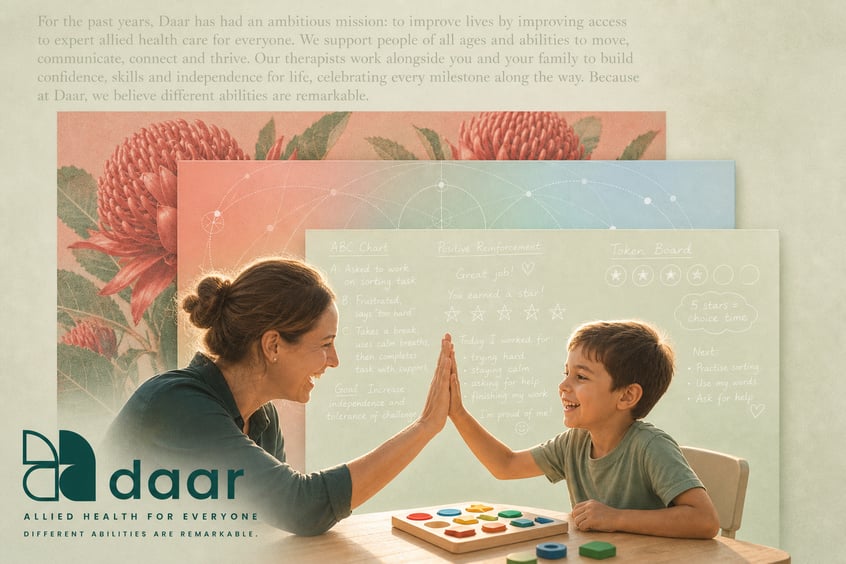
A child's nervous system acts like a mirror to the adults around them. If a parent meets a child's chaotic emotion with their own heightened stress, the child's distress and challenging behaviour will multiply, negatively impacting the quality of life. Conversely, a parent's calm, steady presence acts as a biological anchor.
This process is known as 'co-regulation,' and it is the beating heart of our early intervention therapy format. During our telehealth sessions, our clinicians don’t just work with your child; we dedicate significant time to coaching you. We equip you with the scripts to validate your child's feelings ('Name it to tame it'), strategies to maintain your own emotional boundaries, and the confidence to guide your child safely back to a state of calm, fostering emotional literacy throughout the process.
Conclusion
Emotional regulation is one of the most vital life skills a child can develop, establishing the foundation for healthy relationships, academic focus, and robust mental health into adulthood. With the right support, your child can learn to ride the waves of their emotions throughout their adolescence, enhancing their child’s emotional regulation without being pulled under. These approaches offer structured support and practical strategies to help children understand, express, and manage their emotions in healthy ways.
Ready to build a more resilient household? Reach out to explore a consultation or call daar directly at 02 9133 2500 to find your perfect match.
Frequently Asked Questions
Can emotional regulation support for children help with anxiety as well as anger and meltdowns?
Absolutely. Emotional regulation encompasses the entire spectrum of feelings, tailored to each child’s needs. Whether your child is dealing with explosive frustration, freezing from social anxiety, or even struggling to calm down from extreme over-excitement or meltdowns, the core therapeutic goal remains the same: helping them recognise their physical state and supplying them with the tools to safely navigate back to an emotional baseline.
My child is non-verbal; can they still benefit from positive behaviour support for children?
Yes. Emotional regulation does not rely solely on spoken words. For non-speaking children or those who use Augmentative and Alternative Communication (AAC), we adapt our therapy, conducted by our experienced behaviour support practitioners, to focus on visual emotion scales, Key Word Sign, and heavy sensory-motor regulation strategies (like deep pressure or swinging) to help them develop communication skills, process feelings, and communicate their internal state.
Is behaviour support for children via telehealth covered by the NDIS funding?
Yes. If your child is an NDIS participant, you can use your "Capacity Building - Improved Relationships" or "Improved Daily Living" budgets to access our allied health professionals, including specialist behaviour support. Our services are aligned with NDIS funding goals focused on emotional regulation, building independence, and improving social/community participation.
.svg)




.svg)