
.png?width=48&height=48&name=Group%201%20(3).png)
























Leo (Name changed for privacy) is a curious and affectionate toddler who loves cars and outdoor play. He lives with his parents and older brother. Leo was referred to daar after his parents noticed he was not meeting typical speech milestones for his age.
Presenting Issues:
- Limited Vocabulary: At 3 years old, Leo had fewer than 20 spoken words, whereas typical development suggests a vocabulary of 200+ words.
- Frustration-Based Behaviour: Due to his inability to communicate his needs, Leo frequently resorted to screaming, throwing toys, or hitting when he wasn't understood.
- Social Withdrawal: Leo struggled to play with peers at childcare because he couldn't verbally join in games or express his ideas, leading to isolation.
The Challenge
For Leo’s parents, the silence was deafening, but the screaming was heartbreaking. They felt a deep sense of helplessness as they watched their son struggle to connect with the world around him.
Impact at Home & School:
- At Home: Daily routines were a struggle. Simple choices like "milk or water" became meltdowns because Leo couldn't say what he wanted. His parents felt like they were constantly guessing, and when they guessed wrong, the frustration exploded.
- At Childcare: Educators reported that Leo was often on the periphery of the group. While other children were engaging in imaginative play, Leo would play alone. When another child took a toy, Leo would bite or hit because he didn't have the words to say "Mine" or "Stop."
- Parental Anxiety: Leo’s mother worried about his future schooling and whether he would ever catch up. She felt judged by other parents when Leo had a meltdown in public, fearing they saw a "naughty" child rather than a frustrated one.
We were waiting for him to just 'grow out of it,' but the gap was getting wider. daar didn't just teach him words; they gave him a way to be heard. The first time he said 'Mummy' clearly, I cried.
daar Therapy Approach
Leo’s family partnered with daar for a multidisciplinary approach. We combined Speech Therapy with Positive Behaviour Support (PBS) to address both the communication delay and the resulting behaviours.
Key Interventions Implemented:
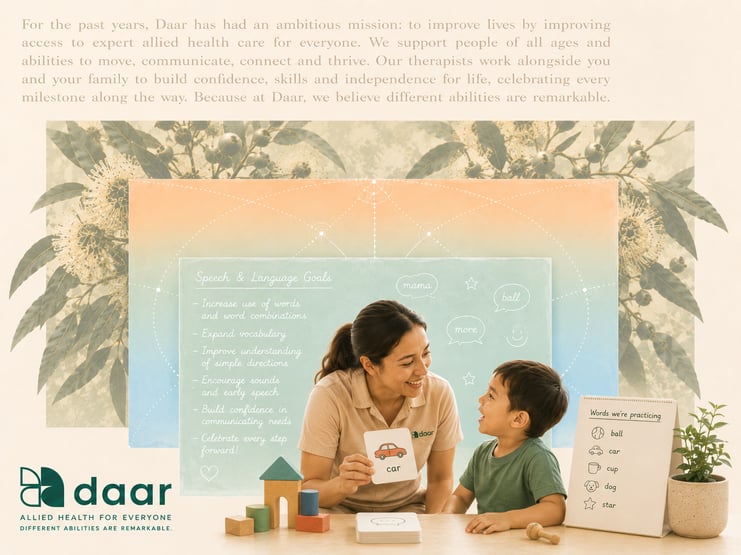
- Functional Communication Training (FCT): We immediately introduced a picture exchange system (PECS) to give Leo a voice while his speech developed. He learned to hand over a picture of a "car" to get the car. This reduced frustration instantly.
- Play-Based Therapy: Our sessions looked like play! We used Leo’s love of cars to model language. "Car go fast," "Red car," "Crash!" We used high-energy, repetitive games to encourage imitation of sounds and words.
- Parent Coaching: We taught Leo’s parents the "Hanen" principles—observe, wait, and listen. We showed them how to narrate their day ("Mummy is cooking," "Leo is washing hands") to bathe him in language without pressure.
- Social Stories: To help with childcare, we created simple social stories about "Using Words" and "Asking for Help," which his educators read to him daily.
- Behaviour Replacement: We taught Leo a physical sign for "Help." When he started to get frustrated, we would gently prompt him to sign "Help," and then immediately assist him, reinforcing that communication works better than screaming.
.svg)

Results and Progress
The combination of giving Leo a way to communicate (pictures/signs) while working on his speech created a breakthrough. Once the pressure was off, the words started to come.
Measurable Improvements:
- Vocabulary Explosion: Within 6 months, Leo’s vocabulary grew from 20 words to over 150 words. He began combining two words ("More juice," "Big truck").
- Behaviour Reduction: Aggressive incidents at childcare dropped by 80% as Leo learned to use his "Help" sign and simple words to navigate conflict.
- Social Engagement: Leo now participates in circle time and has started initiating play with peers, saying "Chase me!" or "My turn."
- Family Connection: The daily meltdowns have been replaced by conversations. Leo can now tell his parents what he wants for a snack, or which book he wants to read.
Key Outcomes
Leo’s journey highlights the critical link between communication and behaviour.
- Behaviour is Communication: Leo wasn't "naughty"; he was unheard. Giving him a voice solved the behaviour.
- Early Intervention is Key: Addressing the delay at age 3 prevented it from becoming a long-term academic or social deficit.
- Empowered Parents: Leo’s parents moved from feeling helpless to being his best language teachers.
increase in spoken vocabulary (20 to 150+)
reduction in aggression at childcare
word phrases used consistently

Conclusion
A speech delay doesn't have to define your child's future. At daar, we understand that every child finds their voice in their own time, but they don't have to do it alone. Our behaviour therapy for children and speech pathology services work hand-in-hand to unlock your child's potential.
If you are worried about your child's speech or the behaviour that comes with it, don't wait and see.
Ready to help your child find their voice?
Contact daar today to book a consultation with our speech and behaviour specialists.



Get access to quality, Efficient, and professional care.
Request a call to find out how daar can help you achieve your health goals.

Leading source of information for allied health news, studies and resources.

We support you to be self-determined and independent, giving you the control and freedom to achieve your individual goals

We provide superior quality, client-centric and innovative treatment to support you to realise your full potential
.svg)




.svg)