
.png?width=48&height=48&name=Group%201%20(3).png)
























Oliver (Name changed for privacy) is a sweet and observant boy diagnosed with autism spectrum disorder (ASD). He lives with his parents and older brother. While he has a deep fascination with spinning objects and lights, Oliver has significant delays in functional communication and social interaction.
Presenting Issues:
- Communication Delays: Oliver was non-verbal and relied on pulling adults by the hand to get what he wanted.
- Social Disengagement: He showed little interest in peers or family members, often retreating into his own world.
- Frustration-Based Tantrums: Due to his inability to express his needs, Oliver would frequently drop to the floor, scream, and cry for extended periods.
The Challenge
Oliver’s parents felt disconnected from their son. They longed to hear his voice and see him play with his brother, but the wall of silence seemed impenetrable.
Impact at Home & School:
- At Home: Mealtimes and routines were a struggle. Without words, Oliver couldn't say if he was hungry, tired, or in pain. His parents felt helpless, constantly guessing what he needed while trying to soothe his intense frustration.
- At Preschool: Oliver would wander the perimeter of the Playground alone. He didn't respond to his name or join in group activities like circle time. Teachers were concerned about his lack of engagement and his safety, as he would sometimes try to leave the classroom unnoticed.
- The Gap: As his peers began to talk and play together, the gap between Oliver and other children his age was widening rapidly.
We were skeptical about ABA at first, worried it might be too rigid. But the team at daar made it all about play. Oliver runs to his therapist when she arrives. Hearing him say 'Mum' for the first time... there are no words for that feeling.
daar Therapy Approach
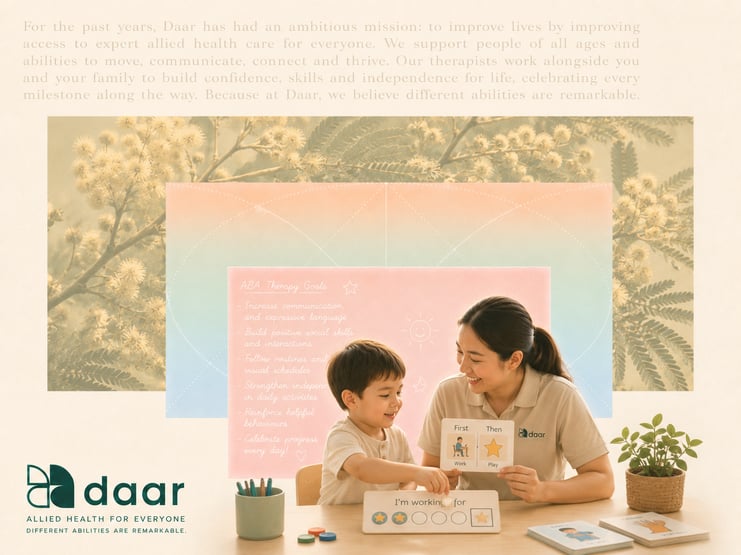
Oliver’s family turned to daar for an evidence-based solution. We implemented a personalized Applied Behaviour Analysis (ABA) program, focusing on early intervention to build foundational skills.
Key Interventions Implemented:
- Discrete Trial Training (DTT): We broke down complex skills into small, teachable steps. For example, learning to identify objects started with matching identical pictures, then matching pictures to objects, and finally requesting the object.
- Natural Environment Training (NET): We took learning out of the therapy room and into his daily life. If Oliver wanted a toy on a high shelf, we used that natural motivation to teach him to point or make a sound to request it.
- Positive Reinforcement: We identified what motivated Oliver—light-up toys and bubbles—and used these as immediate rewards for positive behaviours like making eye contact or attempting a sound.
- Socialised Behaviour Therapy: We facilitated structured play dates with a peer model. Therapists guided Oliver to take turns and share, rewarding every small interaction to build his social confidence.
- Parent Coaching: We taught Oliver’s parents the principles of ABA, empowering them to reinforce his learning at home. They learned to wait for a request (even a gesture) before providing an item, turning every interaction into a learning opportunity.
.svg)

Results and Progress
Over 12 months of consistent therapy, Oliver’s world opened up. The frustration that once ruled his day has been replaced by a growing ability to communicate and connect.
Measurable Improvements:
- Communication: Oliver has moved from being non-verbal to using over 20 functional words and short phrases (e.g., "want juice," "open door").
- Social Engagement: He now responds to his name 80% of the time and will independently approach his brother to initiate chase games.
- Reduced Tantrums: The frequency of frustration-based tantrums has dropped significantly as his ability to communicate has improved.
- School Readiness: Oliver now sits for 10 minutes during circle time and participates in song actions with his classmates.
Key Outcomes
Oliver’s journey highlights the transformative power of behaviour therapy for children when applied early and consistently.
- Foundational Skills: Oliver has built the core skills—communication, attention, and imitation—that are essential for all future learning.
- Family Connection: The barrier between Oliver and his family has crumbled. They can now share jokes, play games, and understand each other.
- Path to Independence: By learning to express his needs, Oliver is taking his first steps toward independence and self-advocacy.
new functional words and phrases mastered
success rate in responding to his name (up from 10%)
of sustained attention during group circle time

Conclusion
Every child has the potential to learn and grow. Applied Behaviour Analysis (ABA) provides the roadmap to unlock that potential, turning challenges into milestones.
If you are concerned about your child's development or behaviour, don't wait. Early intervention with daar can change the course of their future.
Ready to see your child thrive?
Contact daar today to learn more about our personalized ABA programs and positive behaviour support.



Get access to quality, Efficient, and professional care.
Request a call to find out how daar can help you achieve your health goals.

Leading source of information for allied health news, studies and resources.

We support you to be self-determined and independent, giving you the control and freedom to achieve your individual goals

We provide superior quality, client-centric and innovative treatment to support you to realise your full potential
.svg)




.svg)