
.png?width=48&height=48&name=Group%201%20(3).png)
























Liam is an energetic and affectionate boy who loves building complex Lego structures and playing with his dog. He lives with his parents and younger sister. Liam has a diagnosis of Autism Spectrum Disorder (ASD) and Attention Deficit Hyperactivity Disorder (ADHD).
Presenting Issues:
- Aggressive Outbursts: When faced with a change in routine or a difficult task, Liam would often react with physical aggression, including hitting, kicking, and throwing objects.
- Task Refusal: Liam frequently refused to complete schoolwork or participate in household chores, often shutting down or running away when demands were placed on him.
- High Anxiety: Liam exhibited signs of high anxiety, particularly in noisy or unpredictable environments, which often triggered his challenging behaviours.
The Challenge
Liam’s parents were receiving daily incident reports from his childcare centre. The constant feedback about "bad days" was demoralizing and created a sense of dread around pick-up time.
Impact at Home & School:
- At School: The educators were struggling to manage Liam’s behaviour while caring for the other children. They felt ill-equipped to de-escalate his meltdowns and were concerned about the safety of the other students. There were discussions about reducing his attendance days or even expulsion if the behaviour didn't improve.
- At Home: Liam’s parents felt helpless. They saw a sweet, loving boy at home who was misunderstood at school. The stress of potential expulsion was affecting their work and mental health. They worried that Liam was being labeled as "the bad kid" before his education had even really begun.
- Developmental Delay: Because he was constantly being removed from the group for safety reasons, Liam was missing out on critical social learning opportunities and early literacy activities.
We were terrified Liam would be asked to leave the centre. The daar team didn't just save his spot; they changed the whole environment. Now, the educators tell us about his wins, not his incidents.
daar Therapy Approach
Liam’s family engaged daar to implement a Childcare and Schools BT (Behaviour Therapy) program. We knew that clinic-based sessions alone wouldn't solve the problems happening in the dynamic environment of a classroom. We needed to be on the ground.
Key Interventions Implemented:
- In-Situ Support: A daar Behaviour Technician (BT) worked alongside Liam in the childcare centre for 3 days a week. This allowed for real-time intervention and coaching.
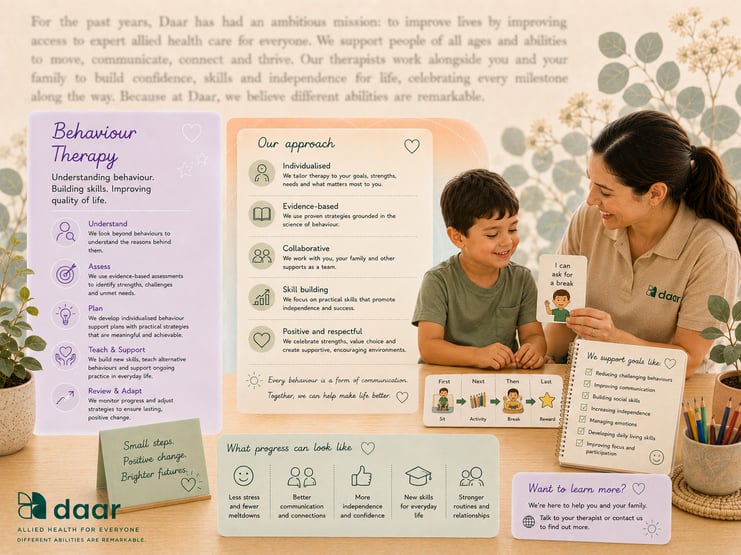
- Functional Communication Training (FCT): We identified that Liam’s aggression was often a result of not being able to ask for what he wanted. We introduced a picture exchange system (PECS) and taught him to use a "Help" card instead of hitting.
- Visual Schedules: We created a personalized visual schedule for Liam that mirrored the classroom routine. This gave him predictability and reduced his anxiety about transitions.
- Educator Coaching: The BT didn't just work with Liam; they coached the educators. We modeled how to use "first/then" language ("First sit, Then ball") and how to spot the early warning signs of a meltdown to intervene before it escalated.
- Positive Reinforcement: We implemented a "Superhero Token Board." Liam earned a token for every 5 minutes of "safe hands" and "listening ears." When he collected 5 tokens, he got access to his favourite superhero cape for 5 minutes.
.svg)

Results and Progress
By bringing the therapy into the school, we transformed the environment from one of conflict to one of support. Liam learned that he could get his needs met with words and pictures, not fists.
Measurable Improvements:
- Aggression Reduction: Incidents of hitting and biting dropped by 95% within the first 8 weeks. Liam now uses his communication book to request items or a break.
- Group Participation: Liam now sits for the entire 15-minute circle time and participates in the actions for songs (previously 0 minutes).
- Social Inclusion: Peers have started inviting Liam to play again. He has a "buddy" system where a peer helps him with transitions, fostering a sense of belonging.
- Educator Confidence: The childcare staff reported feeling "empowered" and "capable" of supporting Liam, and the discussions about expulsion were completely withdrawn.
Key Outcomes
Liam’s success story highlights the critical importance of Childcare and Schools BT.
- Context Matters: Skills learned in a quiet room don't always transfer to a noisy classroom. Teaching in the natural environment ensures skills are "sticky."
- Capacity Building: We didn't just help Liam; we upskilled the educators, leaving a legacy of knowledge that benefits all children in the centre.
- Preserving Placements: Effective behaviour support can be the difference between a child being included or excluded from mainstream education.
reduction in physical aggression incidents
duration of participation in circle time (up from 0)
expulsions or suspensions since starting BT

Conclusion
Every child deserves the chance to learn and play alongside their peers. At daar, our socialised behaviour therapy and positive behaviour support programs are designed to bridge the gap between a child’s challenges and their potential. We work with schools to create inclusive environments where everyone wins.
If your child is struggling in their learning environment, don't wait for a crisis.
Ready to support your child's success at school?
Contact daar today to learn more about our specialized Childcare and Schools BT programs.



Get access to quality, Efficient, and professional care.
Request a call to find out how daar can help you achieve your health goals.

Leading source of information for allied health news, studies and resources.

We support you to be self-determined and independent, giving you the control and freedom to achieve your individual goals

We provide superior quality, client-centric and innovative treatment to support you to realise your full potential
.svg)




.svg)