
.png?width=48&height=48&name=Group%201%20(3).png)























9 October, 2026

Empowering Social Communication Skills and Autism Today
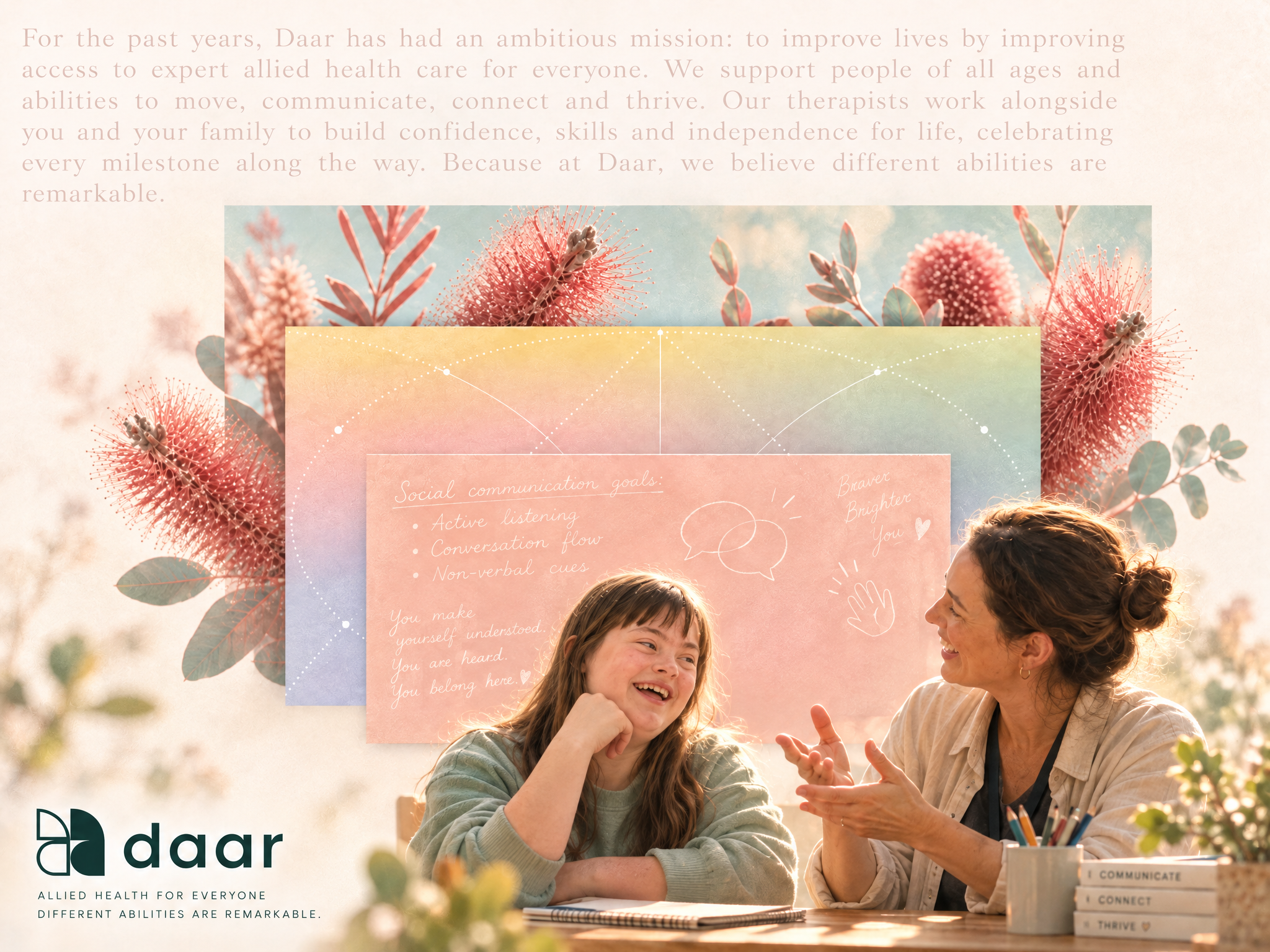
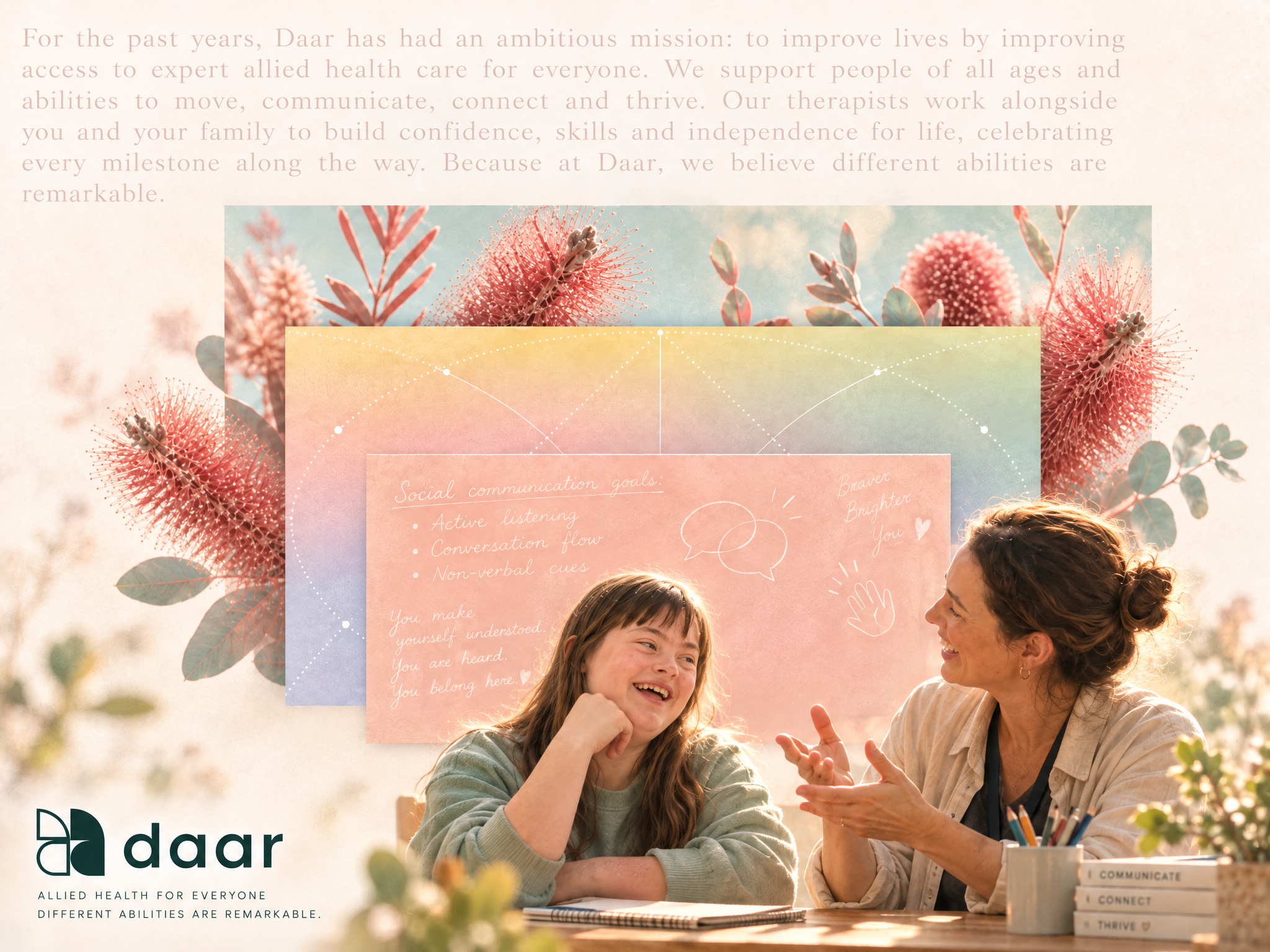
When we think of "social communication," we often picture children having a back-and-forth conversation, making eye contact, or playing a structured game together. But for autistic individuals, social communication and social development, along with various communication challenges and support strategies, are often much broader, deeply nuanced, and heavily intertwined with behaviour, including the understanding of social cues.
As we explored in our article, How Behaviour Therapy Can Support Communication Skills, behaviour and communication are two sides of the same coin. For many autistic children, a meltdown, a sudden withdrawal from a noisy room, or a specific repetitive movement isn't just "acting out"—it is a profound and valid form of social communication.
At daar, we believe that helping autistic children develop social communication skills starts with decoding these behaviours, including understanding body language and nonverbal cues, adapting the environment, and addressing communication differences while building foundational skills in a way that feels safe and supportive.
Behaviour Is Communication
Before a child can navigate the complex social dynamics of an Australian Playground or preschool, younger children need a reliable way to express their basic needs for language development. When a child lacks the verbal words (or the augmentative tools) to say, "I am overwhelmed," or "I don't understand the rules of this game," their behaviour does the talking for them.
If a child runs away during group time, they are effectively communicating a boundary through their unique communication styles, which may include the experiences of neurodivergent people and may have sensory sensitivities influencing this behaviour, potentially leading to behavioural challenges. Our role as therapists and parents is not to simply 'stop' the running, but to understand the message behind it. Once we understand what the behaviour is trying to achieve, we can introduce supportive communication tools—like a 'break' card or a gesture—to help them express that need more easily in social settings.
The Building Blocks of Social Communication
Social communication (often called pragmatic language) involves the unspoken rules of interaction. For autistic children, we focus on developing foundational building blocks at their own pace:
1. Joint Attention
Joint attention is the ability to share focus on an object or event with another person, which can be particularly important for children experiencing social anxiety. It’s the moment a young child points to a passing dog in the park and looks back at you to make sure you saw it too. It is a critical early social skill that can be enriched by understanding figurative language. We support this by entering the young children's world and following their interests, rather than forcing them to focus on ours.
2. Play Skills
Play is the primary language of early childhood. However, autistic people often play differently. A child might prefer lining up cars rather than racing them. We support social communication by joining them in their preferred play style (parallel play) and slowly introducing gentle, interactive elements, teaching them how to share space and group activities with others on their own terms.
3. Understanding Social Context
Social rules can be confusing and highly abstract. Why do we whisper in a library but shout on the sports field? We use practical strategies to help autistic children, who may be diagnosed with a spectrum disorder, decode these environments, thereby reducing stress levels and the anxiety that often leads to challenging behaviours.
Practical Strategies for Australian Families
You don't need a clinic room to practice social communication. Here are a few ways parents can integrate skill-building into everyday life:
- Follow Their Lead: If your child loves trains, use trains to build social interaction. Sit face-to-face, take turns rolling the train down the track, and pause to see if they initiate the next turn.
- Use Visual Supports: Social situations change quickly, which can be highly anxiety-inducing. Use visual schedules or "social stories" before attending a birthday party or a busy family BBQ to explain exactly what will happen and who will be there.
- Model the Language of Emotion: When you see a behaviour occurring, narrate it calmly. "I see you covering your ears. It is very loud in here. Let's go outside." This connects their internal feeling to a social communication strategy.
How daar Bridges the Gap
Developing social communication skills, including nonverbal communication, is rarely a job for just one type of therapy, including ABA therapy. At daar, we champion a collaborative, multidisciplinary approach. By combining the insights of speech pathology (how to express the message) with behavioural support (understanding the environment and triggers), we provide a holistic roadmap for your child's development. Our approach is neurodiversity-affirming, which means we respect and celebrate each child's unique ways of thinking and interacting. Instead of trying to 'normalise' behaviours, we focus on building meaningful, authentic communication skills that work for your child’s individual strengths and needs. Social communication support at daar is flexible, person-centered, and designed to foster self-advocacy, confidence, and connection.
Developing social communication skills is rarely a job for just one type of therapy. At daar, we champion a collaborative, multidisciplinary approach. By combining the insights of speech pathology (how to express the message) with alternative communication methods and behavioural support (understanding the environment and triggers), we provide a holistic roadmap for your child's development, particularly for those with Autism Spectrum Disorder.
Whether we are supporting you in-clinic or remotely via Telehealth, we equip your family with the tools to reduce frustration, foster genuine connection, and help your child navigate their social world with confidence through positive reinforcement.
How to hone your communication and social skills?
To enhance communication and social skills, practice active listening, engage in role-playing scenarios, and seek feedback from peers. Additionally, family members participating in social groups can provide real-world experience. Consistent practice and exposure to diverse interactions will build confidence and improve understanding of social cues for individuals on the autism spectrum.
Ready to support your child’s communication journey? Contact the team for a consultation or call daar at 02 9133 2500 today to learn how our NDIS-registered allied health professionals can create a tailored plan for your family.
Frequently Asked Questions
My child acts out during playdates. Is this a behavioural issue or a communication issue?
It is almost always both! When children don't have the social communication skills to negotiate sharing a toy, ask a peer to stop doing something, or express sensory overload and overwhelm, they rely on behaviour (like pushing, crying, or hiding) to get their message across. Treating the communication gap often resolves the behavioural response.
Can speech therapy actually help with play skills?
Absolutely. Play is the foundation of early social communication. A speech pathologist doesn't just work on talking; they also help develop critical language skills and work heavily on interaction, especially for children showing early signs of autism or delayed speech. We use play-based therapy to teach critical social concepts like turn-taking, sharing attention, reading facial expressions, and initiating interaction with peers.
Can we use NDIS funding to support both behaviour and social communication?
Yes. The NDIS recognises that communication disorders and behaviour, which may also pertain to developmental disability, are deeply connected. Funding under the Capacity Building - Improved Daily Living category can be used to access speech pathology and behavioural support services at daar, helping your child, especially those who are 12 months of age and older, build the social and emotional regulation skills they need for everyday life.
.svg)




.svg)