
.png?width=48&height=48&name=Group%201%20(3).png)























21 September, 2026

Effective Child Anger Management Strategies for Parents
Key Highlights
- Knowing why your younger children's behaviour is angry is important, but parents also need a practical toolkit for the exact moment the storm hits, especially when addressing potential behavioural problems.
- Effective child anger management strategies move away from verbal reasoning and lean heavily into "somatic" (body-based) regulation to process the adrenaline spike safely.
- Building emotional literacy when the child is completely calm is one of the most effective ways to help children manage big emotions before they escalate, including understanding that verbal abuse is a harmful expression of emotions.
- Managing angry outbursts in children isn't just about the meltdown itself; how parents handle the "repair phase" afterward dictates how quickly the child's nervous system recovers.
- Delivered securely via telehealth, daar’s allied health professionals use the "mediator model" to coach Australian parents on implementing these specific, sensory-based strategies during real-life routines.
Introduction
When your child is actively throwing toys, screaming, or lashing out, theoretical psychology goes out the window. In the heat of the moment, parents do not need a lecture on brain development—they need practical, actionable coping skills, helpful strategies, and guidance on how to express anger in a healthy way that recognizes anger as a natural emotion, while also addressing any inappropriate behaviour to keep everyone safe and de-escalate the room for the next time this occurs.
While understanding the root cause of distress is the foundation of therapy, daily survival requires immediate, tangible tools for addressing anger issues and difficult emotions in healthy ways during calm moments. At daar, our allied health professionals focus heavily on equipping families, including local children, with these exact resources and new skills. Let’s move beyond the theory and explore specific child anger management strategies, proactive ways to help children manage big emotions, and how our telehealth clinic supports you in mastering these tools at home.
Proactive Play: Ways to Help Children Manage Big Emotions
The best time to learn about anger is when the child is completely happy. You cannot teach a child how to swim while they are drowning.
One of the most effective ways to help children manage big emotions is through "emotional body mapping" during calm play. Sit with your child and draw an outline of a person. Ask them, "Where does anger live in your body?" Some children say their tummy feels hot; others say their hands get tight, or their chest feels buzzy.
By teaching them the physical warning signs of anger, they can begin to recognise the internal shift before they lose control. We often pair this with a visual "Emotion Thermometer" on the fridge, giving the child a non-verbal way to point to the "orange zone" to signal they are getting overwhelmed, allowing parents to intervene early.
In the Heat of the Moment: Child Anger Management Strategies
When the thermometer hits the "red zone" and an explosion occurs, verbal instructions will only escalate the feelings of anger and the situation. The child's body, like that of young people, is flooded with adrenaline and cortisol. The most effective child anger management strategies at this developmental stage are somatic—meaning we use the body to regulate the brain in appropriate ways, acknowledging that anger is a normal emotion, especially during difficult situations.
Instead of demanding quiet, try these sensory-based de-escalation tools to help children manage strong emotions:
- Heavy Work (Proprioception): Adrenaline requires physical release. Direct that energy safely through physical activity by having the child push as hard as they can against a solid wall, carry a heavy basket of books, or do tightly squeezed "bear hugs."
- Safe Destruction: If the urge to destroy is high, keep a "destruction box" filled with old newspapers or bubble wrap that they are allowed to forcefully rip or pop. It provides the sensory satisfaction of breaking something without causing harm.
- The Temperature Reset: If a child is spiralling, carefully running cold water over their hands or gently washing their face with a cool cloth can trigger the "mammalian dive reflex," which biologically slows the heart rate and forces the nervous system to reboot.
The Aftermath: Managing Angry Outbursts in Children
The way caregivers handle the aftermath of an explosion is a critical, often overlooked element of managing angry outbursts in children.
After a meltdown, a child will often experience a severe energy crash. They might feel deep shame or exhaustion. This is the "repair phase." Do not force an immediate apology or launch into a lecture about what they did wrong. Their brain is still highly vulnerable. Instead, offer a low-demand connection: sit quietly with them, offer a glass of water, and validate their recovery ("That was a really big feeling. You are safe now."). The teaching and reviewing of the event should happen hours later, or even the next day, when their cognitive function is fully restored.
Bringing the Toolkit Home with Telehealth
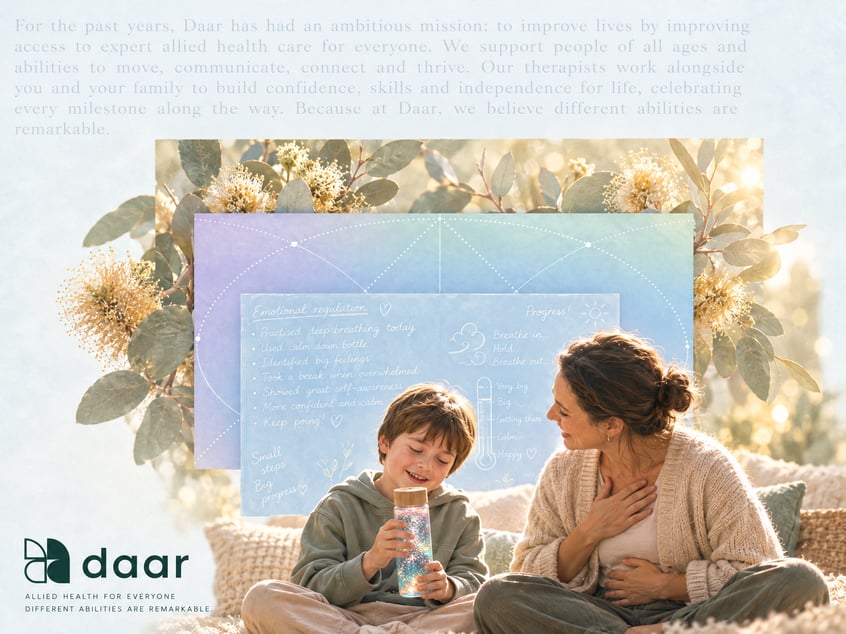
Reading about these tools is one thing; executing them while your child is screaming during the morning school rush is entirely different.
This is exactly why daar operates on the collaborative "mediator model" via an innovative telehealth platform. We don't just hand you a list of strategies. Our practitioners observe your family's authentic environment and coach you live. We help you figure out exactly which somatic tools work for your child's unique sensory profile, guiding you in real-time. To ensure your family is paired with a clinician who deeply understands how to build this customised toolkit, discover telehealth therapy and find your perfect match with our nationwide network.
Conclusion
Navigating explosive emotions is demanding, but by shifting from verbal reprimands to body-based regulation and proactive emotional literacy, you can fundamentally change the trajectory of a meltdown.
You do not have to figure out this toolkit on your own. Expert, NDIS-aligned guidance tailored specifically to your family's needs is available right now.
Reach out to explore a consultation or call daar directly at 02 9133 2500 to find your perfect match today.
Frequently Asked Questions
Are child anger management strategies the same as rewarding bad behaviour, particularly when considering behaviour problems?
Not at all. Providing a child with a "destruction box" to tear paper, or offering a deep squeeze during a meltdown, is not a reward; it is a neurological intervention. We are providing a safe, functional outlet for the adrenaline their brain has released, addressing the underlying emotions that may contribute to their behaviour. Incorporating progressive muscle relaxation into the calming process can also help. Once they are safely regulated and supported by professional help and parent training, we can focus on teaching them proactive communication skills to encourage positive behaviour so the outburst doesn't happen in the first place.
Why does my child’s anger get angrier when I tell them to take a deep breath?
For many neurodivergent children, including young children, focusing on their breathing can actually induce more anxiety or feel like a frustrating demand, especially when they are already overwhelmed by angry behaviours, possibly due to stress related to a family member's situation. This is why our ways to help children manage big emotions often focus on large motor movements (like pushing or jumping) or intense sensory input, which process the stress hormones much faster than sitting still to breathe. Tools like an anger thermometer can also help children visualize and understand their emotions better.
Can NDIS funding be used to help parents learn these child mind anger management strategies for their 5-year-olds?
Yes. Under the NDIS, funding from the Capacity Building: Improved Relationships or Improved Daily Living categories is explicitly designed to fund parent coaching with a clinical psychologist. These sessions empower caregivers, who can serve as role models, to confidently execute these de-escalation and emotional regulation strategies, including understanding body language, safely within the home environment, ultimately preventing aggressive behaviour.
.svg)




.svg)