
.png?width=48&height=48&name=Group%201%20(3).png)























27 August, 2026

Autism Therapy for Children: Tailoring Support to Their Needs
Key Highlights
- Autism therapy supports children across the autism spectrum in communication skills, social skills, and daily routines.
- Effective care often combines behaviour analysis, developmental support, and family involvement.
- Early intervention services can help young children build skills during important learning years.
- Therapy should match your child’s strengths, challenges, and changing needs.
- Speech, occupational, and physical therapy can target specific areas of development.
- Parents play a central role by using strategies during everyday interactions at home.
Introduction
Finding the right support after an autism spectrum disorder diagnosis can feel like a lot to take in. You want clear options that fit your child, your family, and your daily life. The good news is that several therapies can help young children build communication, play, learning, and independence. The best approach is not one-size-fits-all. It is shaped around your child’s strengths, challenges, and the goals that matter most at home and in the community.
Understanding Autism Therapy for Children in Australia
In Australia, autism therapy includes behavioural, developmental, combined, family-based, and therapy-based supports. After an autism diagnosis, families are often guided toward options that build communication, social participation, daily living, and wellbeing during early childhood.
The most effective therapy approaches depend on your child’s needs rather than one set program. For young children, commonly used options include applied behaviour analysis, developmental approaches, Early Start Denver Model, speech therapy, and occupational therapy. Family involvement matters too. The next sections explain what these supports aim to achieve and how they differ.
Key Goals of Autism Therapy
Autism therapy is designed to help children build useful skills that support learning, relationships, and independence. The main goals often focus on social communication, emotional understanding, participation in daily routines, and reducing barriers that affect learning or social situations. Good therapy is practical. It should help your child use new abilities in real life, not only during sessions.
You may see goals such as:
- improving language skills and nonverbal communication
- teaching specific skills for play, self-care, and interaction
- strengthening social communication in everyday activities
- supporting behaviour in ways that improve quality of life
Just as important, therapy should build on your child’s strengths. Some children need help with joint attention or language development. Others may need support with behaviour, transitions, or daily activities. Clear goals help families and professionals work together and shape a treatment plan that feels meaningful and realistic.
How Therapy Approaches Vary Across the Autism Spectrum
Children on the autism spectrum do not all need the same kind of support. Some benefit from structured teaching. Others respond better to child-led learning in play and routine-based settings. Therapy choices should reflect your child’s individual needs, communication style, learning profile, and family priorities.
Here is a simple text table showing how therapy approaches can vary:
|
Therapy approach |
Main focus |
How it is often used |
|---|---|---|
|
Behavioural intervention |
Builds skills through structured teaching and positive reinforcement |
Helpful for specific learning targets and behaviour support |
|
Developmental approaches |
Supports learning through relationships, play, and natural settings |
Useful for communication, engagement, and daily interactions |
|
Combined models |
Blends behavioural and developmental methods |
Often used to create flexible support in everyday routines |
|
Family-based support |
Trains parents to use strategies at home and in the community |
Strengthens learning across daily life |
A strong treatment plan is personalized, not generic. Professionals should adjust goals, intensity, and strategies over time. That gives your child the best possible outcomes and helps therapy stay relevant as needs change.
The Importance of Autism Early Intervention
Early intervention gives young children support during the early years, when many foundational skills are developing quickly. This can include help with communication, behaviour, play, movement, and social connection. Starting early does not mean rushing your child. It means responding when support can have the most positive effects.
For many families, early intervention creates a stronger path for learning in home, preschool, and community settings. It can also help parents understand how to support progress in daily routines. Looking closer at the benefits makes its value easier to see.
Benefits of Early Intervention for Children with Autism
When support begins early, children have more chances to practice and build skills during everyday experiences. This can make learning more natural and consistent. Early services are often designed for very young children, so goals can be woven into play, routines, and family interaction.
Benefits often include:
- stronger communication skills for expressing needs and interests
- improved social skills during play and shared attention
- more opportunities to learn new skills in natural settings
- better outcomes in participation, learning, and daily routines
There is another benefit families often notice. Early support helps parents feel more confident and involved. With guidance from professionals, you can use simple strategies at home and in the community. That steady practice can make progress easier to carry across settings, not just within therapy sessions.
Evidence Supporting Early Intervention in Australia
In Australia, early intervention is encouraged because research shows it supports development in autistic children. Families are guided toward evidence-based approaches, helping them invest time and resources in proven options.
Commonly recommended methods include applied behaviour analysis, developmental-behavioural models like the Early Start Denver Model, speech pathology, and occupational therapy.
Evidence for different therapies varies. Some have stronger support; others show little or no benefit. Families are advised to ask professionals about research backing, expected outcomes, and how each option fits their child’s needs.
Allied Health Supports for Autism
Allied health supports play a major role in autism care. These services often sit alongside broader early intervention services and can target communication, movement, daily living, and sensory needs. Common options include occupational therapy, speech therapy, and physical therapy, depending on the child’s profile.
Parents can learn about evidence-based interventions by speaking with experienced health professionals who work with autistic children. Guidance from qualified teams helps families compare therapy options and choose supports that match real goals. Two key allied health areas are outlined below.
Speech and Language Therapy
Speech therapy is one of the most common supports offered to autistic children. It focuses on language development, understanding, expression, and social communication. A speech pathology program may help your child communicate with words, gestures, pictures, or other systems when spoken language is difficult.
In practice, support can target several areas. A therapist may work on turn-taking, requesting, responding, or using communication during play and routines. Some children benefit from sign language, Key Word Sign, or picture-based systems such as PECS. The goal is functional communication that helps in daily life.
What matters most is fit. Speech therapy should reflect your child’s current skills, interests, and communication style. When parents use strategies at home, progress can carry into meals, playtime, preschool, and community activities, where communication matters most.
Occupational Therapy and Sensory Integration
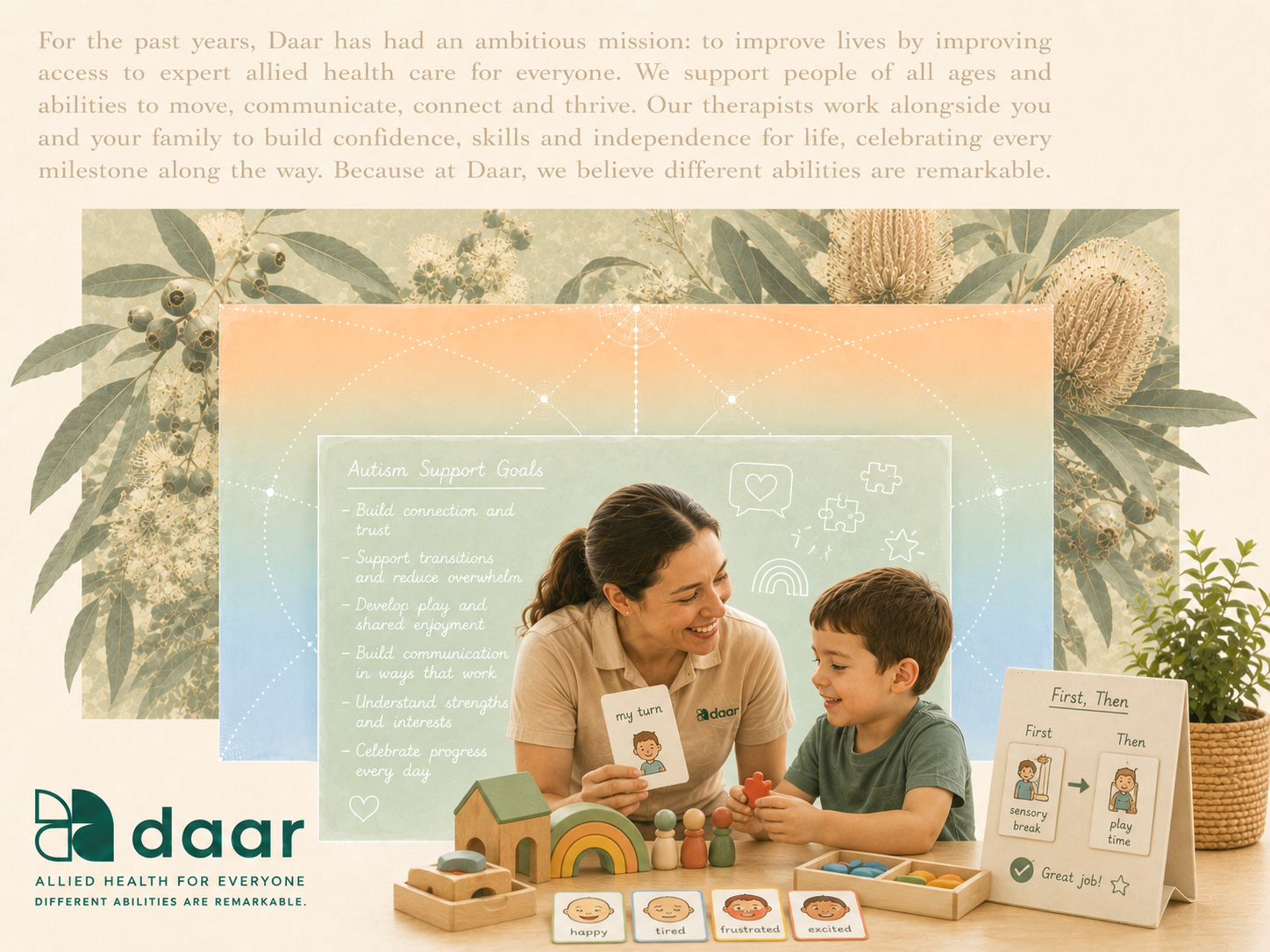
Occupational therapy helps children build skills needed for everyday life. This can include dressing, feeding, play, handwriting readiness, and participation in routines at home or preschool. It often focuses on fine motor skills, sensory processing, and practical independence.
Some children also need support with movement. Occupational therapy may address coordination and body awareness, while physical therapy can help with gross motor skills such as walking, balance, and larger physical movements. When sensory integration is part of care, activities are used to support how a child responds to touch, sound, movement, and other input.
These supports work best when they connect to real tasks your child does every day. Rather than teaching skills in isolation, therapists aim to improve function in daily activities. That makes progress easier to notice and more useful for family life.
Conclusion
In conclusion, tailoring autism therapy to meet the unique needs of each child is essential for fostering their development and well-being. By understanding the specific goals and approaches within the spectrum, families can make informed decisions that promote positive outcomes. Early intervention plays a crucial role, providing children with the tools they need to thrive in their environments. Additionally, accessing allied health support like speech and occupational therapy can further enhance their learning experiences. Parents need to explore available resources and funding options to ensure they receive the necessary help.
If you have questions or need guidance, please reach out to our team for a consultation or call daar at 02 9133 2500 to discuss the best strategies for your child.
Frequently Asked Questions
What factors should parents consider when choosing autism therapy for their child?
Parents should look at their child’s needs, child’s strengths, and the goals they want to support in daily life. It helps to ask whether the approach uses evidence-based interventions, how it fits into a treatment plan, and whether parent training is included so strategies can continue at home.
How can families access autism early intervention services in Australia?
Families often begin after an autism diagnosis by speaking with health professionals who can guide referrals and therapy choices. Early intervention services for young children may be provided in clinics, homes, preschools, or other natural settings. Some families may also seek support through the National Disability Insurance Scheme.
Are there government funding options to help with therapy costs?
Yes, some families may get help with therapy costs through the disability insurance scheme. In Australia, the National Disability Insurance Scheme can support eligible children and young people, including services linked to early intervention. Access and funding depend on individual circumstances, needs, and the planning process.
.svg)




.svg)