
.png?width=48&height=48&name=Group%201%20(3).png)
























Julian (name changed to protect privacy) is a bright, highly visual, and analytical five-year-old boy. He has a remarkable memory and a strong fascination with digital puzzles, interactive apps, and animated videos. However, Julian’s relationship with technology had become a significant roadblock to his daily functioning.
Julian was presenting with severe screen dependency and intense emotional dysregulation. Whenever it was time to turn off the tablet or transition away from the television, Julian would experience massive behavioural meltdowns. He would scream, throw the device across the room, kick the furniture, and become verbally aggressive toward his caregivers. In addition to these presenting behaviour issues, Julian was extremely withdrawn. He preferred the predictable, looping videos on his screen over the unpredictable nature of interacting with other children. Desperate to restore peace in their home and help their son engage with the real world, Julian’s parents contacted the multidisciplinary experts at daar for targeted support.
The Challenge
Without clear, structured boundaries and functional communication skills, Julian's screen time habits were severely impacting every aspect of his and his family's life:
- At Home: The daily routine was held hostage by the tablet. If the battery died or a parent attempted to enforce a screen time limit, Julian would enter a state of severe distress that could last up to an hour. Because of this, his parents often gave in and returned the device just to maintain peace, inadvertently reinforcing the dependency. Mealtimes and bedtimes were chaotic, and his parents felt completely exhausted and trapped.
- At School: Julian’s transition into his early learning center was hindered by his digital fixation. He showed zero interest in the sensory or imaginative play zones. Instead, he would isolate himself, occasionally attempting to sneak into the educator’s office to find a computer. When blocked from doing so, he would disrupt the classroom. His lack of offline play meant he was missing out on critical developmental peer interactions and foundational school readiness skills.
Julian needed an intervention that didn't just arbitrarily take the screens away, but actively taught him how to transition safely and find joy in the offline world.
Therapy Approach
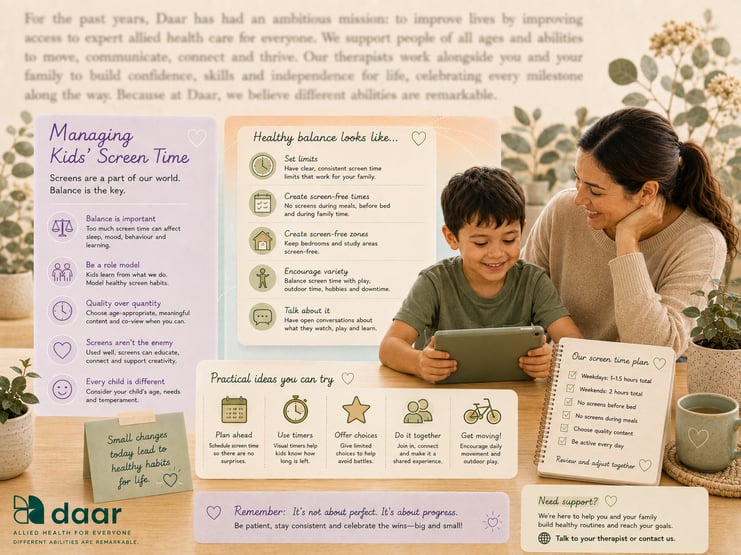
The clinicians at daar approach digital dependency not with punishment, but with understanding. We recognize that taking away a highly preferred item from a deregulated child without providing a supportive bridge will only escalate the conflict. To guide Julian, we developed a highly structured plan rooted in skill-building.
Our comprehensive, family-centered strategy utilized a blend of proven methodologies:
- Functional Behaviour Assessment (FBA): The first step in our behaviour therapy for children was determining the exact triggers. Our behaviour support practitioner identified that Julian’s meltdowns were triggered by the abruptness of the screen removal. Because of his receptive language delay, a parent yelling "Turn it off now!" was startling and confusing.
- Proactive Positive Behaviour Support (PBS): We implemented a robust positive behaviour support plan focused on predictability. We introduced highly visible countdown timers (like a large digital sand timer) so Julian could visibly see his time decreasing. We entirely removed abrupt transitions; instead, we offered a "first / then" visual schedule (e.g., "First 5 minutes of iPad, Then build a block tower").
- Collaboration with Speech Therapy: Working side-by-side with a daar speech pathologist, we integrated speech therapy to give Julian the language of negotiation. We taught his parents how to teach him to request "one more minute" or say "I am finished," substituting his physical aggression for functional, empowering communication.
- Socialised Behaviour Therapy Integration: To address his isolation at school, we utilized socialised behaviour therapy. We coached his early childhood educators on how to slowly introduce Julian to his peers using his existing interests. They used physical puzzles that mimicked his favorite app games to bridge the gap between digital and physical play, rewarding him heavily with praise when he shared a piece with a classmate.
.svg)

Results & Progress
The implementation of these structured, empathetic strategies transformed the dynamic at home and school. By removing the element of surprise and giving Julian a sense of control over his transitions, the need for explosive meltdowns plummeted.
At home, the introduction of visual timers changed everything. Julian learned that the end of screen time wasn't a punishment, but simply the start of a new, engaging routine. Within eight weeks, the hour-long tantrums over the iPad dropped to minor, quickly resolved protests. At school, using digital-themed physical toys as a bridge successfully drew him out of isolation. Julian began participating in collaborative building games with his peers, no longer endlessly searching for a screen.
Reduction in distress when screens are turned off.
Successfully transitioned from digital isolation to active classroom inclusion.
Gained the ability to appropriately ask for "more time" via speech therapy.

Key Outcomes
Addressing challenging behaviour related to screen time requires teaching replacement skills and implementing environmental predictability. Julian’s journey highlights several life-changing outcomes:
- Restored Emotional Regulation: Giving Julian a visual representation of time (timers) eliminated the anxiety of abrupt transitions, allowing his nervous system to stay calm when the tablet was put away.
- Increased Functional Communication: By teaching him the vocabulary to negotiate and express frustration, Julian no longer needed to resort to physical aggression to have his voice heard.
- Enhanced Social Development: Bridging the gap between his digital interests and the real world allowed Julian to safely enter offline play, resulting in meaningful friendships and inclusion at his early learning center.
- Empowered Family Dynamic: Rather than feeling held hostage by a device, his parents were equipped with proactive, evidence-based tools. Setting limits became a calm, cooperative process rather than a daily battle.
Conclusion
In today's digital age, screen time challenges are incredibly common, but for children with neurological or developmental differences, abrupt transitions can feel deeply traumatic. Unplugging a child shouldn't mean entering a war zone. By stepping back and understanding the "why" behind the meltdown, and by utilizing collaborative positive behaviour support, we can create predictable, safe environments. Teaching foundational communication and self-regulation skills empowers children to step away from the screen and back into the real, vibrant world around them.
As Julian’s mother reflected on their progress:
"Before we found daar, the iPad basically ran our house. We were terrified to take it away from him because the screaming that followed would completely derail our entire day. The team at daar taught us that Julian wasn't trying to be naughty; he was just terrified of the sudden change. They showed us how to use visual timers and taught him how to ask for finishing time properly. It sounds so simple, but it completely changed our lives. Julian plays with blocks now, he plays with his sister, and the daily device wars are finally over."
Are battles over screen time boundaries causing severe distress, anxiety, or aggression in your household? You do not have to resort to constant conflict or give in to demands just to maintain the peace.
Bring calm, structure, and connection back to your daily routines.
Reach out to the expert allied health and behaviour support practitioners at daar today. We can help you build an individualized, practical plan to establish healthy limits and foster offline success. Call us at 02 9133 2500 or visit our website to secure your consultation today


Get access to quality, Efficient, and professional care.
Request a call to find out how daar can help you achieve your health goals.

Leading source of information for allied health news, studies and resources.

We support you to be self-determined and independent, giving you the control and freedom to achieve your individual goals.

We provide superior quality, client-centric and innovative treatment to support you to realise your full potential.
.svg)




.svg)